By the time blue met red at EITARO, neither color belonged entirely to itself anymore.
They overlapped in translucent layers, producing purples that seemed to shift as the models walked. Yellow slipped over coral. Pale blue hovered above skin. Organza made one garment visible through another, as though Eitarou Kamimura had decided that instead of telling us what his Spring/Summer 2027 collection meant, he would let color explain it.
I found myself watching those intersections more than the individual shades.
Kamimura built the collection around “脱,” or “Datsu,” a word associated with shedding, breaking away and moving beyond. But his interpretation avoids the usual clean-slate fantasy. Moving forward, in his world, does not require pretending the past never happened. Experiences accumulate. Memories remain. Each carries its own color, and when enough of those colors overlap, they create something that could not have existed without everything underneath.
It is a surprisingly generous way to think about change.
Fashion is very good at declaring something over. A season ends. A trend dies. A wardrobe gets replaced. EITARO is interested in what refuses to disappear. After the restrained palette of Kamimura’s previous collection, SS27 lets color enter almost like evidence that life has happened.
Organza becomes the perfect accomplice. It reveals while obscuring, allowing colors, bodies and garments to coexist rather than compete for the foreground. Sometimes the clothes resemble memories themselves: recognizable from a distance, harder to define once you get close.
That is where EITARO SS27 became most interesting to me.
Peach haze

The pale yellow and coral minidress looks almost edible, somewhere between a peach gummy and sunlight passing through a glass of rosé.
Its shape is deliberately uncomplicated. A sleeveless, loose body falls away from the torso before gathering softly near the thighs. But the simplicity is deceptive. The translucent yellow outer layer allows the coral beneath it to glow rather than merely sit there. The colors seem to produce each other.
I like that Kamimura does not overload the idea. There is no need for embroidery, hardware or theatrical construction. Transparency does the talking. Even the dark red pointed shoe feels like a small punctuation mark at the end of a very soft sentence.
Ripple effect

Here, pale blue expands into a floor-length dress bordered by rippling seams that trace the body like contour lines on a map.
The fabric refuses to sit completely still. Its large side panels create movement around the legs, while the layered edges give the dress an almost topographical quality. I thought of water disturbed by a stone, with one ring becoming another and another.
A chunky silver chain at the neck interrupts all that softness. Good. Without it, the dress might become too dreamlike. EITARO lets something hard enter the picture, and suddenly the woman wearing it seems less like a floating apparition and more like someone firmly occupying the room.
False denim

This is where the collection starts playing tricks.
A pale zip jacket appears almost like washed denim at first glance, but its cloudy surface has the character of something remembered rather than something physically worn down. Beneath it, tiny gray shorts are interrupted by a loose piece of blue organza hanging from the hip.
I love the imbalance. One side seems dressed, the other unfinished. The jacket belongs to the street. The floating fabric belongs somewhere else entirely.
That tension makes the outfit feel young without trying to advertise youth. It resembles the way people actually build identities now, pulling references from sportswear, vintage clothing, nightlife and the internet without worrying whether everything comes from the same chapter.
Signal mixing

Purple can become obnoxiously self-important in fashion. Here, it feels electric.
A sheer violet wrap top sits above wide gray trousers, allowing flashes of blue and magenta to move across the torso. The trousers, meanwhile, are relaxed enough to nearly swallow the shoes.
This may be one of the collection’s most immediately wearable ideas, but it still carries Kamimura’s larger argument. Look closely at the purple and it refuses to remain simply purple. Blue and red seem to coexist inside it.
The effect reminds me of an old television screen caught between signals. Colors interfere with one another, but the interference becomes the image.
Red interrupts

A large rectangle of icy blue fabric hangs from the shoulders and turns the torso into something close to a canvas.
The exposed collarbones are important. They stop the garment from overwhelming the wearer, while the long side openings allow the arms to emerge from what otherwise looks like a beautifully oversized panel. Beneath it, checked shorts introduce a mundane little pattern against all that ethereal blue.
Then come the red shoes and sheer red socks.
That jolt is exactly what the outfit needs. Blue asks you to relax. Red refuses. Together, they create the kind of visual disagreement I want from a runway.
Dots depart

Polka dots arrive, and suddenly EITARO sounds a little cheekier.
The white halter top twists and folds around the neck instead of behaving like a conventional blouse. Black dots scatter across its surface, while saturated blue trousers drop loosely from an elastic waist.
There is something almost Pop Art about the graphic contrast. I thought briefly of Yayoi Kusama, although Kamimura’s dots are not obsessive or immersive. They function more like interruptions.
What makes the outfit work for me is its refusal to choose between sophistication and ease. The top could belong at a gallery opening. The trousers could survive a convenience-store run at midnight. Why should those lives be separate?
Yellow aside

White organza falls over a long polka-dot skirt, with a yellow piece of fabric carried casually at the side.
The white top is especially beautiful because it almost disappears. Its layered triangular edges give it the appearance of several handkerchiefs placed carefully over one another. The body remains visible underneath, so white does not mean emptiness here. It becomes another layer.
The yellow fabric in the hand fascinated me. It looks less like an accessory than a thought temporarily removed from the outfit.
Against the black dots, that yellow becomes impossible to ignore. Sometimes the smallest patch of color carries the loudest memory.
Dress recess

This outfit feels like someone escaped a classroom and headed directly into a club.
A white textured button-down is pulled and gathered at the waist, while beneath it sits a bulbous miniskirt in layers of blue and purple. Mauve socks and dark shoes make the styling even stranger and more charming.
The proportions are deliberately adolescent. Oversized sleeves meet a tiny, inflated skirt. But the transparency and color keep it from becoming a literal schoolgirl reference.
Instead, I see the awkward freedom of figuring yourself out. The outfit has the energy of getting dressed without asking whether your choices will make sense to somebody else.
That might be one of the most adult freedoms there is.
Gathered up

Now the organza becomes something to physically hold.
Blue transparent fabric wraps around a magenta base while bright red trousers emerge underneath. A yellow scrunchie-like cuff circles the wrist. The model grips the fabric against the chest rather than simply allowing the garment to hang.
That gesture changes everything.
Suddenly, layering is not merely a visual technique. It feels protective and intimate, almost like gathering a blanket around yourself. Blue, purple, red and yellow occupy the same body without canceling one another out.
I find this look particularly persuasive because it turns Kamimura’s color theory into something emotional without becoming sentimental.
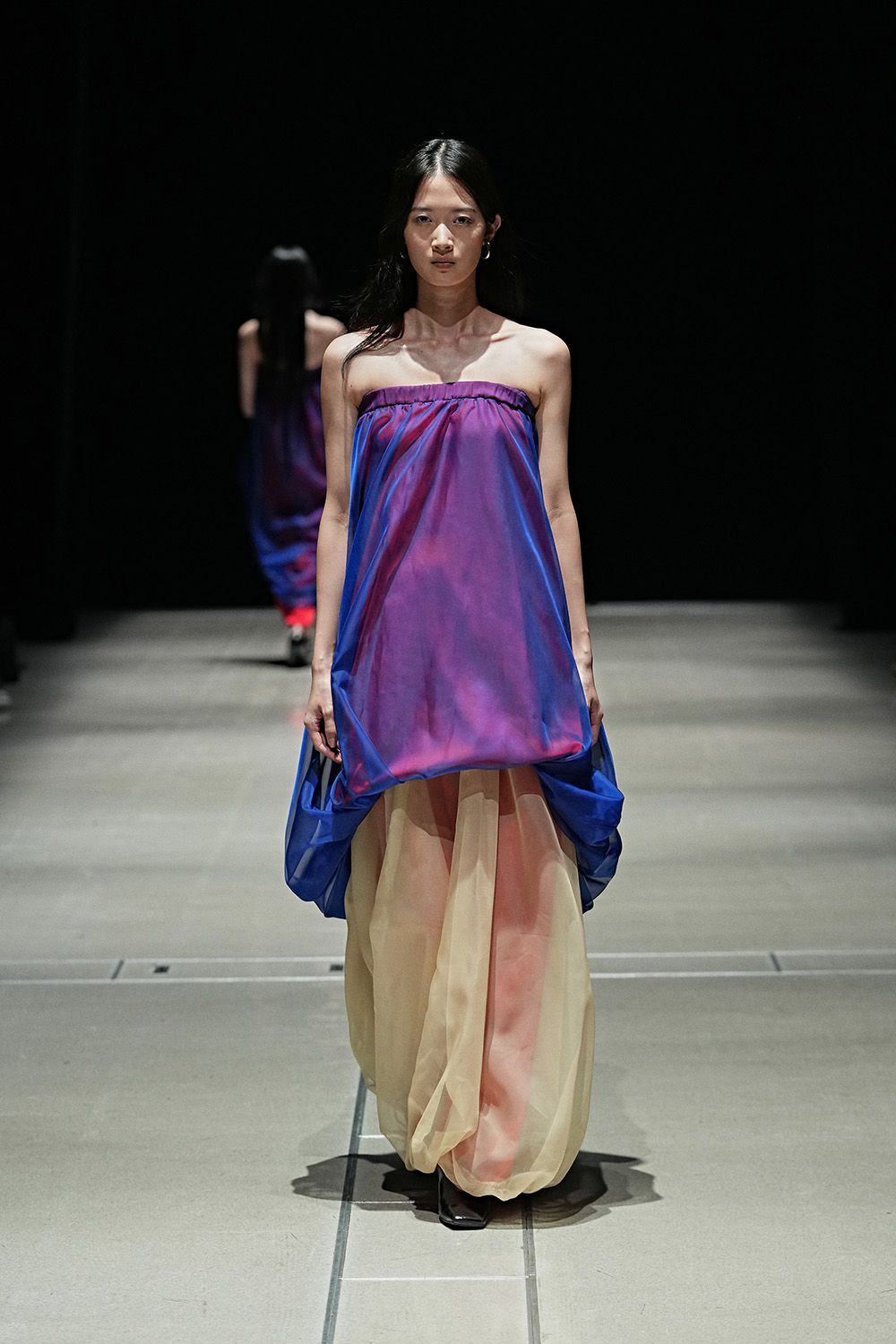
Chromatic collision

Here is the collection’s thesis in clothing.
A strapless purple-and-blue organza dress floats above a pale yellow and coral layer reaching toward the floor. The upper portion looks almost digitally saturated, while the lower half becomes softer and warmer.
You can practically watch one color enter another.
There is a Rothko-like pleasure in that relationship, not because the garment imitates his paintings, but because color itself becomes the subject. You stop asking what shade something is and start noticing what happens when one field encounters another.
The body becomes the place where those encounters happen.
That feels quintessentially EITARO. Clothing is not simply covering the person. It is showing how the person was assembled.
Almost invisible

Of the images here, this one pushes transparency furthest.
A long, almost colorless organza column covers the body like a sheet of glass. Fine blue and yellow edges outline its perimeter, while ghostly white markings run across the surface. Behind the model, enormous pieces of colored fabric trail across the runway like discarded skins.
I kept returning to this image.
The garment appears nearly empty until you notice how much information is trapped inside its transparency. Light, shadow, skin, seams and the runway itself all become part of the dress.
It is a clever endpoint for this selection of images because it makes visibility complicated. To see through something is not necessarily to see nothing. Sometimes transparency reveals how many things were there all along.
Keep the color
EITARO is still a young label. Kamimura founded it in 2025, and SS27 represents only its third collection. That makes the clarity of this developing language particularly interesting. Organza, oversized proportions, exposed bodies and unconventional layering are not being used as decoration. They are becoming a vocabulary.
What stays with me most is Kamimura’s refusal to treat transformation as erasure.
Fashion loves the fantasy of the “new you.” New season, new wardrobe, new haircut, new body, new life. It can make yesterday feel embarrassingly obsolete. EITARO offers a more humane proposition. Yesterday does not vanish simply because tomorrow arrives.
Maybe we are all a little like these clothes. One color placed over another. A bad year beneath a good one. Childhood under adulthood. Embarrassment beneath confidence. People we once were still faintly visible through whoever we are trying to become.
I find that idea far more interesting than reinvention.
The best moments in EITARO SS27 occur when you cannot immediately identify where one color ends and another begins. Purple is not just purple. It contains blue and red. A transparent dress is not empty. It contains the person, the room and whatever happens to stand behind it.
Kamimura understands something worth carrying beyond the runway: Moving forward does not always require leaving pieces of ourselves behind.
Sometimes we simply learn how to wear all those colors at once.
EITAROは今、自分だけの色彩言語をつくり始めたばかりなのかもしれない。だからこそ、上村英太郎がこれから透ける素材や色彩をどこまで押し広げていくのか、その過程そのものを見ていたくなる。東京から生まれた若いブランドが、次の季節にはどんな景色を見せてくれるのだろう。EITAROの次の一色を、楽しみに待ちたい。
Leave a Reply