A bedroom is one of the few places where dressing does not necessarily begin with an audience.
Before the door opens, clothes can be incomplete. A stocking can remain half-pulled. A shirt can hang incorrectly. Underwear can become an outfit simply because nobody has yet decided otherwise. Getting dressed is less performance than negotiation between the body, the mirror and whatever version of yourself you intend to send outside.
That private interval sits at the center of Seivson’s Spring/Summer 2027 collection, “閨房 / BOUDOIR.” Designer Tzu Chin Shen takes the boudoir, historically associated with a woman’s private room, and pushes its contents into public view. Lingerie escapes from underneath clothing. Corset structures become visible. Lace meets jackets. Pearls travel across T-shirts. Garments seem caught somewhere between being put on and taken apart.
Showing the collection inside Tokyo’s Hatoyama Hall makes the idea even more interesting. The former private residence became a public space, mirroring a collection preoccupied with the same migration. Models moved through rooms while performing gestures associated with getting ready, including touching their hair and applying lipstick. The audience was effectively invited into a ritual usually conducted behind a closed door.
What I like most is that Shen does not treat exposure as simply showing more skin. Sometimes revealing yourself means adding something. Sometimes protection can be transparent. Sometimes underwear can become armor.
These nine looks made me think less about what women are supposed to wear outside and more about why the distinction between “inside” and “outside” clothing existed in the first place.
Private armor

The first image practically diagrams the collection’s argument across the body.
A black bra is exposed rather than concealed, but long sculpted sleeves build substantial architecture around it. Lace travels downward across the torso before meeting a tiny printed skirt trimmed with fringe. Fine chains circle the waist like jewelry that wandered away from the neck.
I love the contradiction. The center of the body is almost bare while the shoulders look prepared for impact.
That is where Seivson’s lingerie-as-exoskeleton idea becomes convincing. Underwear is traditionally the innermost layer, but Shen pulls it forward and surrounds it with volume. The result reminds me of a piece of Victorian portraiture that someone cut apart and reassembled after midnight.
Nothing here asks permission to be categorized as underwear or outerwear. Good. The distinction suddenly feels boring.
Dressing unfinished

This look feels like getting dressed and deciding halfway through that you are already finished.
A black pleated construction falls in uneven tiers around the body, interrupted by an exposed midsection and trousers underneath. The padded collar sits high and wide around the shoulders, almost like a travel pillow redesigned for a particularly severe heroine. Straps and small hardware interrupt the softness.
The pleating is important because it brings order to something intentionally unresolved. Every fold looks disciplined, yet the silhouette refuses conventional completion.
There is something wonderfully human about that. We often imagine fashion as the finished image, but dressing is full of temporary states. Shirt open. Skirt unfastened. One layer waiting for another.
Seivson freezes that private moment and sends it outside.
Pearl trail

Then the room brightens.
A pale, loose top drapes asymmetrically over a short fringed layer, while strands of pearls and chains cross the neck, shoulder and torso. White lace-up sandals continue the lines down the legs.
Pearls usually arrive with rules. They belong to jewelry boxes, formal dinners and carefully buttoned collars. Here they refuse to stay politely around the neck.
I kept thinking of a necklace being removed at the end of an evening and accidentally falling across the body. Shen captures that slightly disordered intimacy and turns it into styling.
The top itself appears almost sleepy, loosely falling rather than standing at attention. Against the more armored black looks, this one feels like morning entering the bedroom.
Hardware romance

Here Seivson gives romance a toolbox.
A cropped black jacket erupts around the shoulders while zippers, lace and textured panels break up its surface. Below, a short structured skirt is crossed by vertical rows of metal hardware, with gray pleats appearing at the sides. Pointed shoes are tied around the ankles with thin black straps.
This is one of my favorites because softness and aggression never separate into opposing camps. They occupy the same garment.
The jacket has the puffed drama of historical sleeves, but the zippers drag it into the present. The skirt could almost be a corset relocated to the hips.
That displacement is clever. Shen keeps taking familiar components and asking why they have to remain where history put them.
Second skin

This look makes exposure strangely elusive.
A translucent flesh-toned ensemble surrounds a dark rectangular panel punctured with irregular openings. Sheer shorts remain visible beneath a floating outer layer, while a black-and-gray head covering obscures part of the face.
At first, I thought of damaged film negatives. Then I thought of Lucio Fontana cutting through canvas to make the space behind an artwork part of the artwork itself.
Those openings perform a similar trick. They make absence visible.
For a collection about private space entering public space, covering the eyes while revealing the body is especially provocative. Visibility is not the same thing as access. Someone can look directly at you and still not possess the whole picture.
After dark

Black mesh stretches across the body like a veil that has decided it would rather be a dress.
The long, transparent silhouette is interrupted by opaque panels, fringe, a high collar and a diagonal line of hardware traveling down the skirt. One shoulder carries additional structure, disturbing what could otherwise have been a straightforward sheer column.
This is where Seivson’s boudoir becomes nocturnal.
I like that transparency does not make the look fragile. Quite the opposite. The dark lines around the body behave almost like a frame around glass. You see through it, but the structure remains unmistakable.
The body is visible, yet Shen still controls exactly how the eye travels across it.
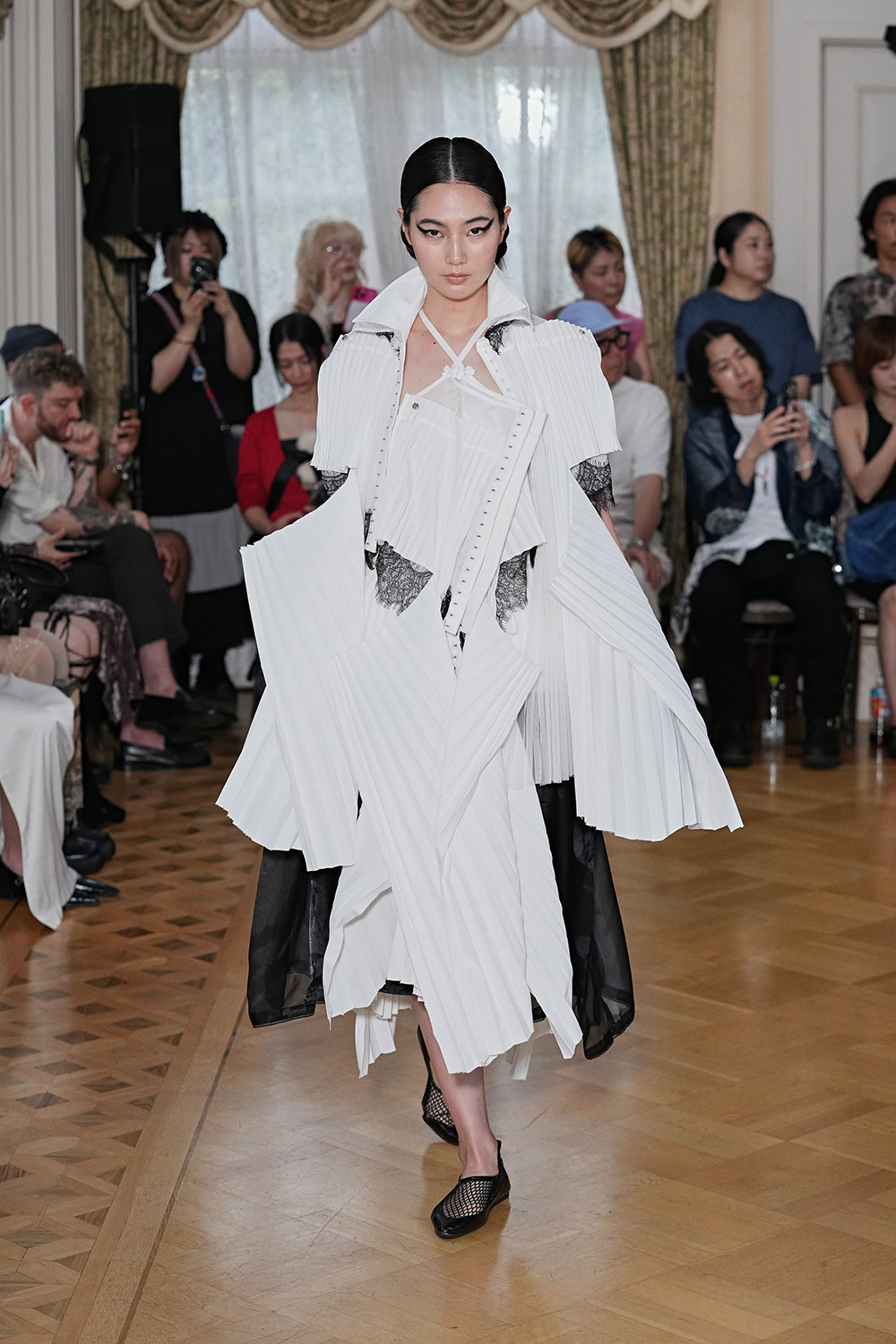
Paper corset

This might be the collection’s most fascinating collision.
White pleats explode outward in panels that resemble folded paper, dismantled blinds or pages from an enormous book. At the center, a corset-like structure pulls everything toward the torso. Black lace peeks through the white construction, while darker sheer fabric hangs beneath.
It feels halfway between origami and an exploded dress pattern.
The visual tension is excellent. Corsetry traditionally pulls inward. Pleating here pushes outward. One contains the body while the other multiplies its space.
If the boudoir is supposed to be a room, Shen effectively makes the garment architectural. The woman is no longer simply standing inside private space. She carries the walls with her.
Soft defense

A pale pink jacket swells around the shoulders like pillows suddenly given military ambitions.
Below it, white netting crosses the exposed torso before meeting a short skirt and patterned tights. Pearls appear again, including a large one positioned at the throat.
The combination could easily become sugary. It never does.
I think that is because Shen keeps disturbing sweetness with structure. Pink is crumpled rather than pristine. Pearls are oversized. The open torso interrupts the jacket’s protective volume.
It reminds me of the strange psychology of a bedroom itself. Soft objects surround us there because vulnerability is expected. Pillows, blankets and curtains are forms of comfort, but also small barriers between the body and everything beyond it.
Seivson turns that softness into defense.
Borrowed shirt

Finally, an oversized striped shirt seems to have escaped someone else’s wardrobe.
Its collar spreads broadly around the neck, white piping draws exaggerated lapels across the chest, sleeves balloon around the arms and the hem breaks into pointed fragments. Delicate embellishments and Chinese-style fastenings interrupt the familiar shirting, while pearls sit at the neckline.
This might be the most everyday proposition among these nine images, which makes its distortions even more satisfying.
Everyone understands a shirt. That familiarity gives Shen something to sabotage.
It also returns me to the collection’s conversation between Eastern and Western dress. Rather than turning those references into costume, Seivson lets different clothing languages overlap. A recognizable Western shirt begins speaking through another vocabulary.
The result feels less like fusion than interruption, and I prefer it that way.
Door open
The strongest thing about “BOUDOIR” is that Seivson never simply drags underwear onto the street and calls the job finished.
The collection asks a more interesting question: Who decides which version of ourselves is private?
Clothing has always helped enforce that border. We have garments meant to be seen and garments historically designed to disappear beneath them. We button one layer over another and, in doing so, construct a socially acceptable exterior.
Shen scrambles that hierarchy.
The bra gets the spotlight. The corset becomes architecture. Stockings become part of the visual argument rather than an accessory hiding below a hem. Pearls slip from polite necklaces into wandering lines across the body. Shirts refuse to behave like shirts. Even softness becomes capable of protecting its wearer.
And Hatoyama Hall quietly completes the thought. A private residence became somewhere strangers could enter. Seivson fills it with clothing undergoing the same transformation.
I find that deeply satisfying because the collection does not make privacy disappear. It makes privacy portable.
There is a difference.
The women in these clothes can reveal lace, skin, underwear and the visual evidence of getting dressed without surrendering control over themselves. A bedroom door may have opened, but Seivson decides how far anyone gets to walk inside.
That feels much more interesting than exposure for exposure’s sake.
Maybe the boudoir was never simply the room.
Maybe it was the woman deciding what leaves it with her.
Seivsonは今季、「着る」という日常的な行為そのものを、もう一度考えさせてくれた。完成された姿だけではなく、服を選び、重ね、崩していく途中の時間にも、その人らしさがある。台湾から東京へと独自の視点を届け続けるSeivsonだからこそ、この繊細さと大胆さが同じ服の中で自然に共存しているのだと思う。次にSeivsonがどんな日常の境界線を動かしてくれるのか、楽しみにしている。
Leave a Reply