Ten years into RequaL≡, Tetsuya Doi seems less interested in preserving the past than asking what happens when you cut it open.
For Spring/Summer 2027, memories are not placed behind glass. They are pulled apart, layered, displaced and sometimes allowed to drag along the floor. Shirts lose their expected shape. Jackets collide with other jackets. Hats wander away from the head. Familiar pieces return looking as though somebody remembered them incorrectly, then decided the mistake was better.
That makes “(re)code × (re)member” an unusually fitting title for RequaL≡’s 10th-anniversary collection, presented Sept. 3 at Rakuten Fashion Week Tokyo. It also marked the brand’s first runway show since Fall/Winter 2023. Doi looked backward, but this never felt like an anniversary retrospective. Instead, he treated a decade of RequaL≡ as raw material.
There is something personal underneath all that reconstruction. Doi once worked at a vintage clothing store, photographing more than 100 garments a day. That history helps explain why these clothes often look accumulated rather than simply styled. They carry the visual disorder of a packed clothing rack, where decades, owners and purposes accidentally meet.
Doi has said, “Without fashion, I wouldn’t be myself.” Looking at this collection, I believe him. These clothes feel less like an anniversary card to RequaL≡ and more like pages ripped from a diary, rearranged and worn on the body.
And some of those pages are very strange.
Paper ghost

White fabric overwhelms the body in overlapping strips, translucent layers, knots and petal-like shapes. From a distance, the silhouette appears almost cloudlike. Up close, it feels far less innocent.
I kept thinking about paper. Not a pristine sheet, but dozens of pages cut apart and assembled into something that can no longer be read in its original order.
That connects beautifully with Doi’s interest in memory. Remembering is rarely clean. We keep fragments, exaggerate details and lose others completely. Here, those fragments seem to physically surround the wearer.
The black sunglasses are important. Against all that white softness, they provide a hard punctuation mark. Without them, the look might drift toward fantasy. With them, it develops attitude.
It is one of those outfits that makes you want to walk around it rather than simply look at it from the front.
Inside out

This look feels like somebody emptied a closet onto the floor, reconsidered everything and discovered a new outfit inside the mess.
A gray hood frames the head while a cropped layer exposes the stomach. Beneath it, familiar sweatshirt shapes appear stretched and displaced. Around all of that sits a distressed outer layer covered in strips of fabric, giving the surface the texture of leaves caught on a coat after walking through a forest.
I love how unfinished it feels without actually appearing incomplete.
There is a difference.
Doi turns construction into something visible and emotional. Instead of hiding the evidence that clothing has been cut, altered or combined, he lets those scars become the language of the garment.
The result looks lived in before anyone has actually lived in it.
Loose threads

A familiar button-up shirt gets interrupted by dozens of narrow fabric strips cascading toward the knees.
This might be one of the clearest examples of RequaL≡ taking an ordinary garment and refusing to accept its boundaries.
The shirt is still recognizable. Collar, buttons and sleeves remain. But its front seems to be unraveling in slow motion.
Below it, denim and knit textures collide in loose, asymmetric trousers. One side appears to carry a piece of another garment entirely, almost as though yesterday’s outfit has been sewn into today’s.
Those dangling strips give the look incredible movement. They trail behind the body like sentences that Doi decided not to finish.
Souvenir suit

There is a wonderfully nomadic quality to this look.
A jacket opens across the bare torso, while oversized beige trousers are covered with pockets, patches, text and mismatched graphic elements. A printed fabric arrangement sits on the head in a shape that falls somewhere between scarf, hat and found object.
The trousers immediately caught my attention. They resemble something that has traveled through several lives, collecting evidence from each one.
Rather than making the patches decorative additions, RequaL≡ makes them look accumulated. That distinction matters. The garment feels like a suitcase covered in old stickers from places its owner refuses to forget.
Against that visual history, the bare chest feels remarkably simple. It gives all those memories somewhere to breathe.
Split personality

A weathered black leather jacket collides with gray tailoring, and neither seems willing to surrender.
That is exactly why I like it.
The leather ends high around the torso while the gray jacket underneath stretches lower, its lapels crossing against bare skin. One belongs to the language of biker clothing, the other to tailoring. RequaL≡ forces them to share the same body.
It feels almost Cubist. Think of a portrait where several perspectives exist simultaneously. Doi does something similar with clothing categories. Instead of deciding whether the wearer is dressed in a leather jacket or a suit, he presents both answers at once.
The exposed legs make the upper-body layering feel even heavier, while the simple shoes bring everything abruptly back to earth.
Check again

This outfit initially looks quieter, but the longer I study it, the stranger it becomes.
A gray outer layer frames black-and-white checked fabric that twists and gathers across the torso. Loose black shorts sit below, while white socks and dark shoes give the bottom half an almost school-uniform familiarity.
Then everything above the knees starts misbehaving.
The checked garment refuses to sit where a shirt normally would. Fabric bunches, turns and exposes parts of the torso unexpectedly. Another checked panel hangs separately from the coat.
That is where Doi’s “recode” idea becomes especially effective. He does not need to invent an alien garment. He can take something everybody understands and change its grammar.
You recognize the words. The sentence has changed.
Hat trick

I laughed when I first noticed the headpiece, in the best possible way.
Several straw-hat forms appear to have collided above the model’s head, curling around one another like an architectural model that escaped the studio.
Below, the clothing remains equally restless. A distressed olive coat is cut with repeated openings, while white shorts hang loosely beneath it. The bare chest gives the look a relaxed confidence.
There is also a flash of a contemporary streetwear logo at the waist, an amusing collision with the almost sculptural headpiece above it.
RequaL≡ is very good at making familiar objects lose their instructions. A hat no longer has to behave like one hat. Clothing does not have to pretend its references come from the same cultural neighborhood.
The absurdity is part of the intelligence.
Dark carnival

Black consumes most of this outfit, but then a bright green object appears at the chest and a richly colored printed textile erupts from one side.
That sudden color feels almost cinematic.
The black jacket and trousers have shredded, textured surfaces that absorb the light unevenly. Then the red, green and gold fabric trails behind like a curtain pulled from another room.
I see a little punk here, particularly in the spiked hair and distressed black layers, but the printed textile complicates that reading. It introduces something ornate and almost theatrical.
This is what RequaL≡ does particularly well. Just when you think you have identified the reference, another one walks into the frame.
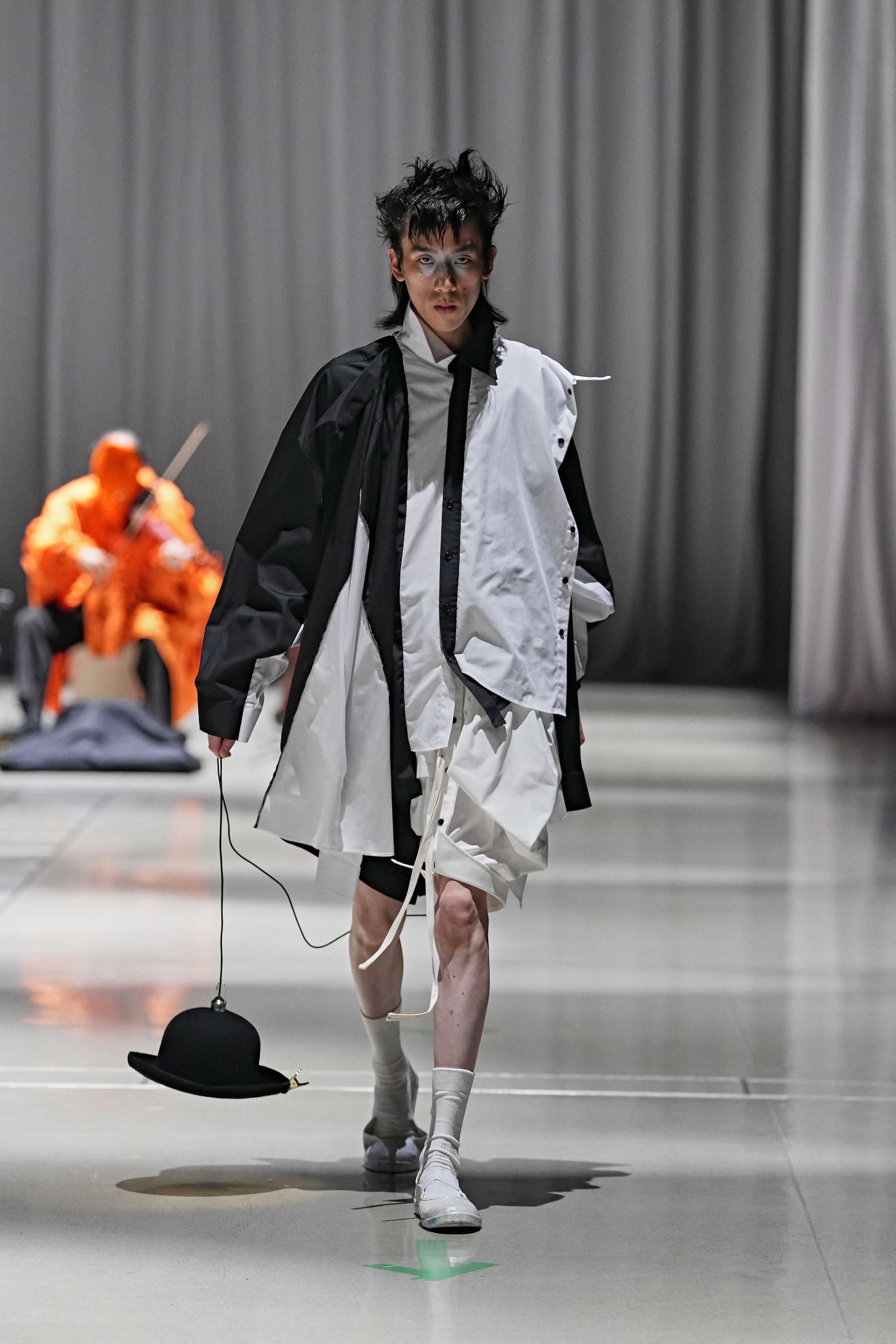
Wrong place

Here, Doi turns displacement into the entire joke.
Black and white shirts appear reconstructed across the body, with panels overlapping and sleeves seemingly arriving from unexpected directions. The shorts continue that fragmented construction.
And then there is the bowler hat.
Except it is not on the model’s head.
The hat hangs from a cord beside the body, transformed into an object that exists somewhere between accessory, prop and lamp. For this anniversary project, RequaL≡ collaborated on a bowler-hat lampshade that actually functions as a light.
It perfectly summarizes Doi’s question: Who decided where things belong?
A collar belongs at the neck until it does not. A shirt belongs on the torso until Doi turns several of them into something else. A hat belongs on your head until somebody gives it a lightbulb.
Fashion becomes much more entertaining once those rules stop feeling permanent.
Dragging memory

This look takes the collection’s idea of displacement and makes it physical.
A sleeveless black leather construction wraps unevenly around the torso, while voluminous gray shorts gather below with long ties spilling from the waist.
Then another piece of clothing appears to trail behind the model.
I love that detail because it almost literalizes memory. The past does not disappear simply because you have moved forward. Sometimes you carry it. Sometimes you reconstruct it. Sometimes it follows several feet behind you across a runway.
The worn leather strengthens that feeling. It already seems to have a history before we know anything about who wore it.
Nothing here sits perfectly where convention tells us it should, which may be the most RequaL≡ thing about it.
Memory error
The smartest thing Doi could have done for RequaL≡’s 10th anniversary was refuse to make an anniversary collection that behaved like one.
There is no need for a neat greatest-hits package when the brand’s history is more interesting as something unstable.
“(re)code × (re)member” understands that memory is a terrible archivist. We forget dates. We combine people. We remember rooms larger than they really were. A smell can suddenly retrieve something we thought had disappeared years ago.
Doi approaches clothing with that same unreliable memory.
His years working around vintage clothing become piles and layers. Previous RequaL≡ ideas return altered. People who have crossed his creative life become collaborators. Familiar garments migrate around the body until their original purpose becomes only one possibility among many.
That makes the collection personal without requiring the audience to know every detail of Doi’s biography.
I certainly do not share his memories, but I understand the instinct behind them. Most of us have an old shirt we cannot throw away, a jacket connected to a particular year or something in our closet that has become more memory than clothing.
RequaL≡ takes that emotional attachment and asks a more mischievous question: What if we cut it up?
After 10 years, Doi does not seem interested in presenting RequaL≡ as a finished idea. That may be the collection’s greatest strength. He treats a decade not as proof that he has found the answer, but as permission to keep questioning the rules.
Where does a shirt begin? Where should a hat go? When does an old garment become a new one? How much can you alter something before the memory attached to it disappears?
I do not think RequaL≡ wants to answer any of those questions.
Good.
Some clothes are more interesting when they leave you arguing with your own wardrobe on the way home.
RequaL≡の10周年を迎えた今、土居哲也の服には完成を急がない強さを感じる。東京のランウェイで見えたのは、過去を保存するブランドではなく、自分自身の歴史を何度でも編集できるブランドだった。服の形だけでなく、RequaL≡という存在そのものが、これから先も変化を受け入れていくのだと思う。次の10年で、その自由な発想がどこまで広がっていくのか見届けたい。
Leave a Reply