Fashion usually asks us to believe in the finished product.
By the time a garment reaches a runway, the pins have disappeared, the loose threads have been clipped and the people who spent hours cutting, sewing and adjusting it have retreated backstage. The audience receives the polished result, not the uncertainty that produced it.
C JEAN challenged that arrangement for Spring/Summer 2027 at Rakuten Fashion Week Tokyo.
For “BECOMING: BOLÉRO,” designer Chun-Yuan Jean opened the atelier and made the process part of the presentation. Worktables, dress forms, thread, fabric and makers in white coats shared the room with the model. Nothing tried to disguise the fact that clothes come from human hands. Instead, the collection asked us to watch those hands work.
I found that more compelling than another conventional procession down a runway. There was no need to manufacture backstage drama because the act of making became the event itself.
The collection takes its name and structure from Maurice Ravel’s “Boléro,” the 1928 composition built around a melody that repeats while the orchestra gradually changes around it. C JEAN translates that idea into clothing through what the brand calls “difference within repetition.” Instead of presenting a sequence of unrelated ideas, familiar shapes, colors, folds and layers return in altered forms.
The clothes do not simply arrive. They become.
Changing form

That distinction matters because “BECOMING: BOLÉRO” was designed around a single body repeatedly changing.
One model does not simply present a conventional sequence of completed looks. She is redressed as layers, colors, weight and silhouette shift around her. The same body becomes a kind of canvas on which the collection keeps revising itself.
It immediately changes the way you watch.
Instead of asking what comes next, I started looking for what had changed.
Cream fabric wraps around the body in large, irregular folds, almost like pattern paper that has escaped the cutting table. The material gathers at the waist before dropping toward the floor, while the neckline folds outward and away from the shoulders. There is enough structure to give the garment authority, but enough irregularity to preserve the sense that someone’s hands have just left it.
I particularly like that tension.
The cream material evokes the neutral cloth and paper associated with the early stages of garment making. Yet C JEAN does not treat that state as something embarrassing that must be hidden before the audience arrives. The process itself becomes worthy of attention.
It made me think of an architect’s paper model. Before steel, glass and concrete give a building permanence, there is often a fragile object made from folded material, held together by cuts and human judgment. C JEAN finds beauty in a similarly temporary state.
Then the collection begins to heat up.
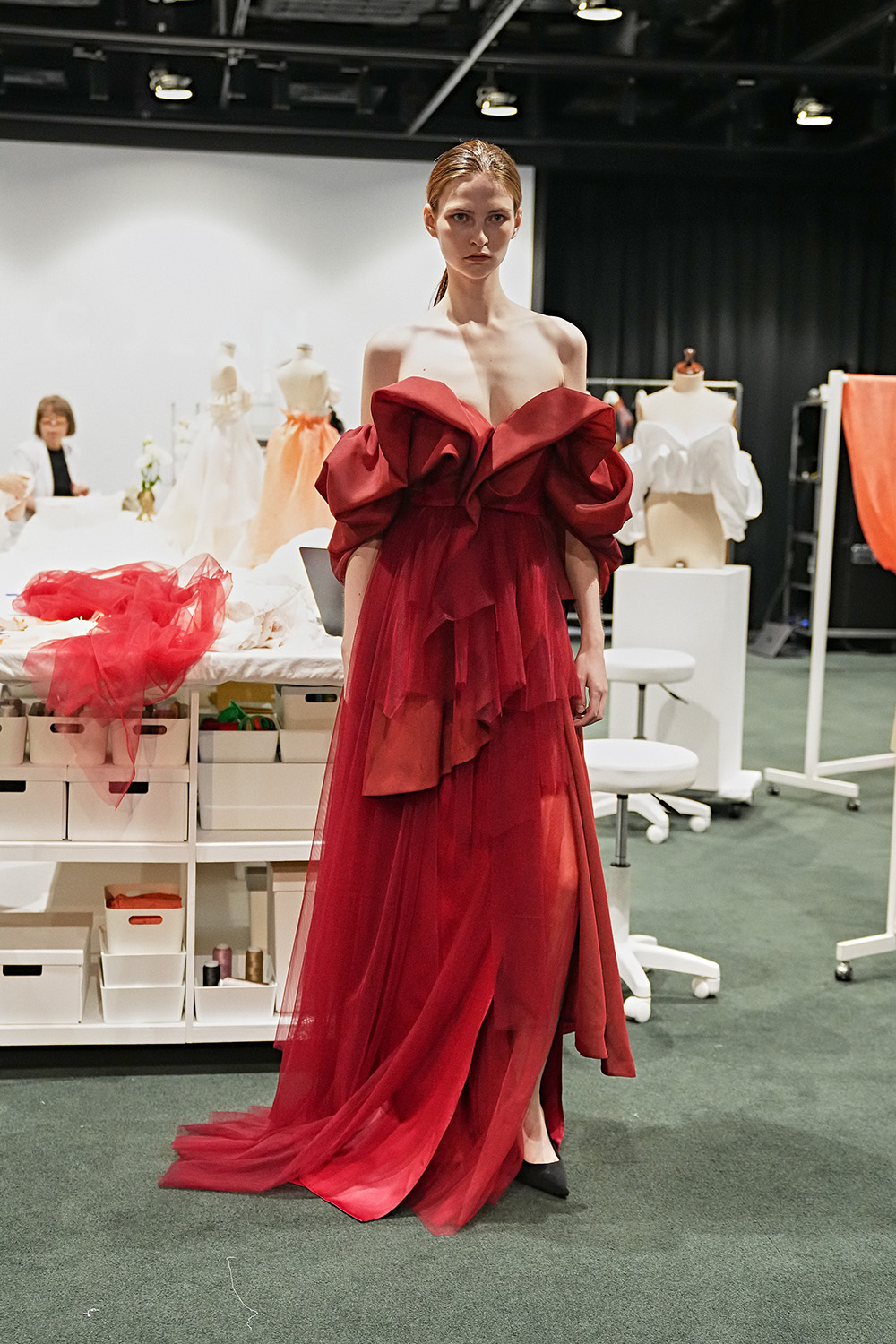
Cream moves into orange and eventually deep red. Familiar folds return, but they refuse to return exactly as we remember them. Fabric swells around the shoulders. Layers overlap. Transparent material allows one shade to bleed visually into another. A long red skirt trails behind the body while enormous folds frame the chest like fabric caught halfway between collapsing and blooming.
This is where the Ravel reference becomes particularly persuasive.
The melody has not disappeared. Another instrument has entered.
Building volume

In “Boléro,” repetition creates momentum because each return carries more weight than the one before it. C JEAN does something similar with fabric.
The deeper the collection moves into red, the more expressive those recurring forms become. What initially resembles paper construction begins to resemble petals, curtains, waves or even wet pigment spreading across a canvas.
One deep red iteration turns the upper body into a mass of folds. They curl around the shoulders and chest without swallowing the person underneath. Below, transparent layers descend toward the floor, shifting in density wherever pieces of fabric overlap.
The color is not really one red at all.
Light passes through it, creating burgundy, crimson and scarlet depending on where the layers meet. It reminded me of looking through overlapping panes of colored glass. The material itself becomes responsible for painting the body.
That progression gives the collection an emotional temperature. Cream feels exploratory. Orange feels increasingly animated. Red feels fully charged.
Yet none of them reads as a simple before-and-after transformation. That would be too easy. C JEAN is more interested in showing that every version contains traces of another.
The folds remain familiar. The relationship between exposure and coverage continues. The body is repeatedly framed, released and wrapped again.
It is repetition without duplication.
That may be my favorite idea in the collection.
Human hands

The clothes, however, are only half of what makes this presentation work.
Behind the model is the atelier itself.
Makers cut, handle and adjust fabric at long worktables. Spools of thread sit on carts. Boxes remain underneath the tables. Dress forms occupy the room alongside partially constructed garments. Scraps of orange and red interrupt an environment dominated by white and cream.
On the screen behind them is a declaration: “THE ATELIER IS OPEN.”
It could have become theater for theater’s sake. Instead, the presentation’s restraint keeps the idea grounded.
C JEAN’s notes make an important distinction: The makers are not actors. They are cutting, stitching, fitting, revising and waiting according to the rhythms of actual work.
That changes their presence.
They are not decorative figures placed there to make the clothes appear artisanal. Their labor is the subject.
At one point, a maker kneels beside the model and physically handles the red fabric while she wears it. The model is barefoot. For me, that image gets remarkably close to the heart of the collection.
Take away the shoe and some of fashion’s usual ceremony disappears. Allow someone to continue working on the garment and another layer of distance disappears with it. The model stops looking like an untouchable endpoint and becomes a participant in an ongoing process.
Suddenly, the garment can change its mind.
There is something deeply human about that.
We are accustomed to fashion photography presenting clothes as settled facts. Everything has been decided. Every button knows where it belongs. Every fold appears inevitable.
C JEAN shows us that none of this was inevitable.
Someone chose where that fold should fall. Someone reconsidered the length. Someone touched the fabric, stepped backward and looked again.
The clothes carry those decisions with them.
Across distance

That emphasis on handwork becomes even more meaningful because the project connects Taiwanese and Japanese artisans working in different spaces.
According to C JEAN’s presentation notes, they are not pretending to occupy the same physical atelier. What connects them is a shared approach to material, accumulated knowledge and the belief that making is a conversation between the hand and whatever it touches.
I appreciate that C JEAN does not flatten those differences into a vague idea of craftsmanship.
Different cultural histories remain different. Different working environments remain visible. The connection comes from practice rather than sameness.
That feels particularly relevant now, when fashion can move around the world faster than the people who make it. An image can appear in Tokyo and reach New York, Manila or Paris almost instantly. The physical work behind that image still takes time.
A needle cannot be hurried into having experience.
A hand cannot repeat exactly the same movement twice.
That tiny difference between one gesture and the next is where “BECOMING: BOLÉRO” finds its character.
Beautiful evidence
What stayed with me most was how little C JEAN seemed interested in hiding evidence.
The uneven fold, the overlapping layer, the visible adjustment and the fabric still being handled all become part of the visual language.
It recalls an artist’s studio more than a conventional fashion show. Think of the paint-splattered rooms left behind by painters, or a sculptor’s workshop crowded with studies and unfinished forms. The mess is not separate from the artwork. It tells you how the artwork learned to exist.
C JEAN applies that logic to clothes.
Fashion has spent decades perfecting the illusion that effortlessness is the highest form of sophistication. “BECOMING: BOLÉRO” quietly proposes something more interesting: What if effort is worth seeing?
I agree.
Seeing the work does not diminish the fantasy. It gives the fantasy a pulse.
The red fabric feels richer when you have watched hands manipulate it. The folds become more meaningful when their variations are understood as decisions rather than decoration. Even the repeated silhouette gains personality because you recognize where it has been before.
The collection makes you remember.
That memory becomes part of looking.
Still becoming
By the end of “BECOMING: BOLÉRO,” I had stopped searching for the definitive version of the garment.
There isn’t one, and that is precisely what makes the collection work.
Ravel’s “Boléro” builds its power by returning to familiar material and refusing to leave it untouched. C JEAN follows the same logic. Fold, layer, expose, gather, repeat. Each return carries the memory of the last one while making room for another possibility.
That idea feels particularly sharp in a culture obsessed with finished images. Clothes appear on our screens already photographed, posted, judged and replaced by the next image. We rarely see the hesitation before the photograph. We almost never see the hand that moved something two inches and decided it finally felt right.
C JEAN puts that hesitation back into fashion.
And I think that is the collection’s strongest move.
“BECOMING: BOLÉRO” does not ask us to admire perfection from a distance. It brings us close enough to see the fingerprints. It reminds us that clothing has a life before the photograph and that creation is not a straight line between an idea and a finished dress.
Sometimes it circles. Sometimes it repeats. Sometimes the same piece of fabric has to be touched again.
The atelier remains open because the work is never entirely finished.
Something is always becoming.
C JEANの服を見ていると、完成した一着だけではなく、そこに至るまでの時間そのものに目を向けたくなる。布に触れる手や少しずつ変わるシルエットが、「BECOMING: BOLÉRO」のリズムを静かに刻んでいた。アトリエを開いたC JEANは、服を見ることと、服が生まれる瞬間を見ることをひとつにした。
Leave a Reply