There is something deceptively difficult about making ordinary clothes feel unfamiliar. Anyone can make noise. It takes considerably more confidence to lower the volume and ask you to look closer.
That was the proposition behind support surface’s Spring/Summer 2027 collection. Its title, “ordinary shift,” came with a concise thought from the collection notes: “A quiet shift from the ordinary / Beyond what is normal, toward what lies ahead.” It is an unusually accurate description of what unfolded on the runway. Designer Norio Surikabe did not treat the everyday wardrobe as something requiring demolition. Instead, shirts, trousers, skirts, lace blouses and dresses seemed to move a few degrees away from their expected positions.
I kept thinking about that word, “shift.” Not transformation. Not rebellion. A shift can be almost imperceptible until you compare where something began with where it ended. That distinction matters here. Familiar garments retained enough of their original identities to be recognizable, but proportion, construction, fabric and color quietly changed the conversation.
It reminded me less of fashion chasing novelty and more of Japanese architecture, where a sliding screen can change the character of an entire room without changing the room itself. The collection worked similarly. A collar moved. A hem wandered. A familiar shirt acquired another layer. Volume appeared where you did not expect it. Nothing needed to shout.
And frankly, I found that restraint refreshing.
Lines in motion

Blue stripes should be among the safest ideas in a wardrobe. They belong to offices, school uniforms and the vast territory of clothes we barely notice anymore. Here, that familiarity becomes the raw material.
A striped blue shirt is paired with a deeper cobalt striped skirt, but the vertical lines refuse to behave uniformly. The skirt is pieced so that stripes change direction and converge into sharp diagonals, creating something close to an architectural drawing in motion. Its uneven hem interrupts the geometry further.
Then there is the collar. One elongated strip slips downward like a necktie that has decided it no longer cares about office hours.
I love how little Surikabe needs to do to change the psychological temperature of something so familiar. The blue shirt remains a blue shirt. The stripes remain stripes. Yet their alignment has been disturbed just enough to make your eyes work harder. It is “ordinary shift” distilled into one outfit.
Soft uniform

This look begins with another familiar vocabulary: white shirting and dark bottoms. Then the proportions begin drifting.
The sleeveless white top folds across the torso with an elongated panel hanging asymmetrically down the front, while dark bands run from the shoulders into the voluminous navy skirt. There is something almost ceremonial about the arrangement, though the effect never becomes costume.
What caught me was the balance between discipline and ease. The upper half looks carefully assembled, while the skirt seems interested in air and movement. The contrast recalls the economy of traditional Japanese dress without trying to reproduce it literally.
This is where support surface becomes particularly convincing. The reference does not need an exclamation point. You sense it rather than being instructed to see it.
Quiet geometry

At first glance, this might be the collection’s most conventional proposition: a pale fitted jacket and a long pleated skirt in muted gray-beige.
But simplicity makes every decision louder.
The rounded neckline is broken by small angular collar points. A single oversized button sits near the chest, almost like punctuation, while the jacket narrows gently before meeting hundreds of disciplined vertical folds below.
I found myself appreciating how grown-up this felt without becoming severe. There is a midcentury precision to it, somewhere between a carefully designed Tokyo interior and the controlled silhouettes of postwar dress, but the elongated skirt keeps it planted in the present.
Sometimes fashion does not need another trick. Sometimes getting the line exactly right is the trick.
Paper wings

Here, a white blouse begins behaving almost like folded paper.
Its sleeves extend outward in crisp, broad planes, while overlapping panels converge around the neckline and fall loosely over wide plaid trousers. The top looks as though someone took a conventional shirt pattern, placed it on a table and began folding sections until another object appeared.
The origami comparison is obvious, but what interests me more is the tension between flatness and volume. Cloth starts as a plane. The body forces it into three dimensions. This blouse makes that transformation visible.
Against the gray plaid trousers, the experiment feels surprisingly wearable. That grounding matters. The trousers tell you this belongs to a wardrobe, not a museum pedestal.
Orange signal

And then orange arrives.
After so much blue, white and gray, the saturated sleeveless top feels like somebody opened a door and let sunlight into the room. Ruffles ripple across the shoulders and chest, but pairing them with extremely wide gray trousers prevents the sweetness from taking over.
This may be one of my favorite combinations because it demonstrates how effectively color can alter proportion. Your eye goes immediately to the compact orange torso before dropping into the long, loose columns underneath.
There is also a tiny flash of blue at the feet. It should be incidental, but it gives the whole composition a playful final period.
The outfit is joyful without begging you to call it joyful.
Lace work

A cream blouse surrounded by lace could easily drift into nostalgia. support surface pulls it somewhere stranger.
Ruffled lace forms pronounced structures around the shoulders and travels down the sides of a striped button-front blouse. The delicacy of the material meets loose brown trousers that look almost utilitarian by comparison.
That collision is what makes the outfit work for me.
Lace carries centuries of associations with decoration, domesticity and formal dress. Here, it is not treated as precious. It becomes architecture around an otherwise straightforward shirt. Pairing it with earthy trousers pulls the material out of the parlor and onto the street.
It feels like finding an old photograph inside a contemporary apartment.
Garden static

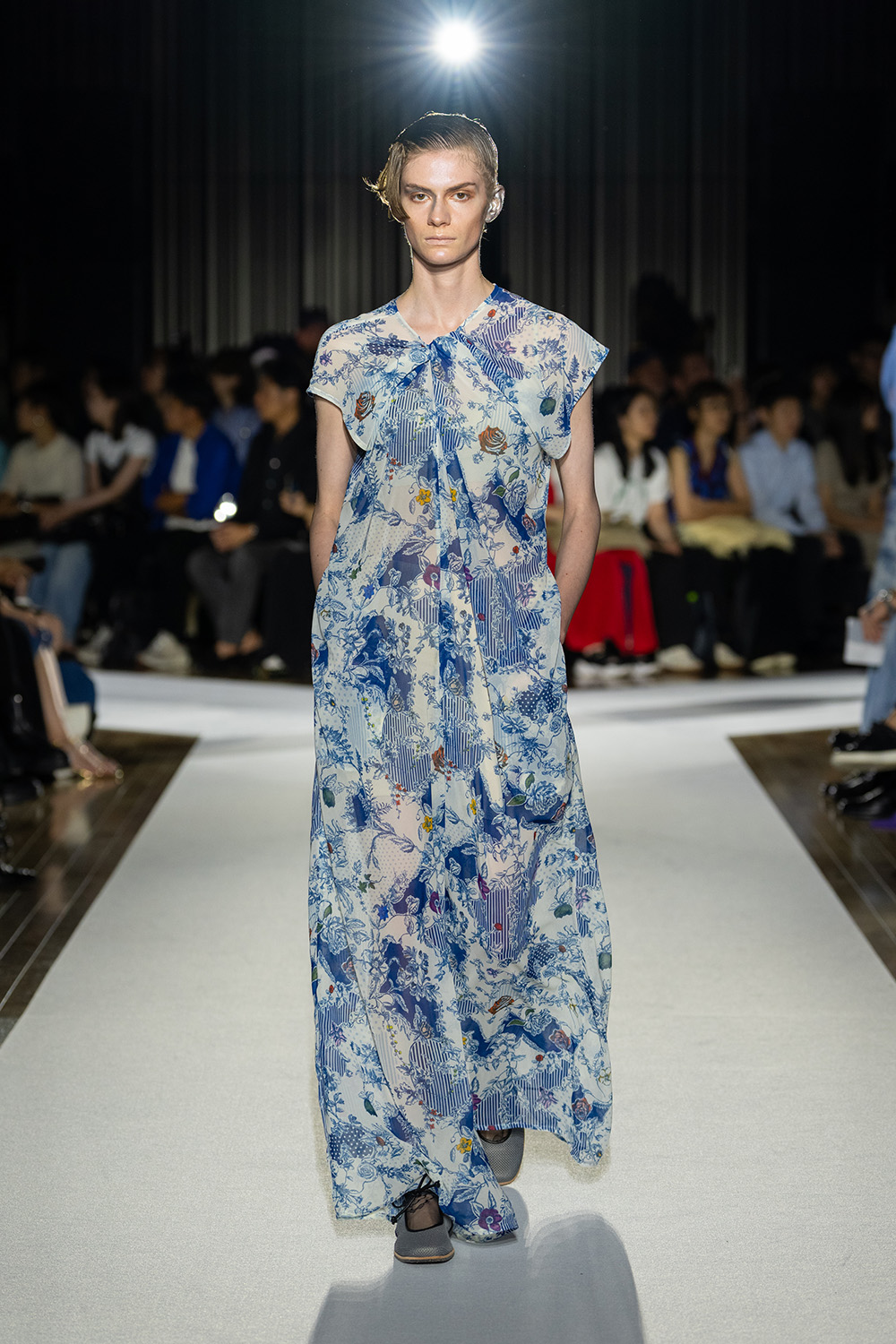
The collection’s printed dress changes the rhythm again.
Blue botanical imagery spreads across a pale ground, interrupted by smaller bursts of color and sections that appear almost patched or layered into the pattern. The silhouette itself remains wonderfully direct: long, loose and largely uninterrupted.
I like that Surikabe lets the textile carry the conversation.
From a distance, the blue-and-white combination recalls porcelain and toile. Up close, however, the density becomes more restless. Flowers, foliage and fragments compete for space like memories layered over one another.
It is romantic, but not sugary. More importantly, it provides a visual exhale between the collection’s experiments with shirting and construction.
Roses in relief

White returns, but this time it has texture.
A translucent cropped top is covered in dimensional floral forms that resemble roses emerging from fog. Beneath it, blue trousers fall in generous, curving volume, their folds giving the lower half a softness that counters the intricate surface above.
The contrast is beautiful because neither element tries to imitate the other.
One is almost tactile enough to read with your fingertips. The other depends on movement.
I also appreciate the refusal to make the floral material overly formal. Putting it with roomy trousers gives the outfit an everyday logic. That is the collection’s thesis again: Take something familiar, move it slightly, and watch its meaning change.
After dark

Black lace changes the emotional register completely.
A dark button-front top is framed by elaborate lace around the shoulders, echoing the cream version seen earlier, while a lace skirt extends below in layers of transparency and density. The exposed sections of skin become part of the composition, breaking what could otherwise have been a single block of black.
There is a slightly Victorian mood here, but the styling refuses historical reenactment. The sporty gray footwear is especially important. It knocks the outfit out of the past and returns it to contemporary Tokyo.
That tension makes the look memorable. Romance meets practicality. Decoration meets movement. History gets sneakers.
Degrees forward
By the end, I understood “ordinary shift” less as a collection title and more as a design method.
Surikabe takes garments whose identities we already understand and asks how far they can move without becoming something else entirely. A shirt remains a shirt. Trousers remain trousers. Lace still carries its history. Stripes still suggest uniforms and workwear. But each familiar element has been nudged out of alignment.
That approach feels particularly relevant now. Fashion exists in a moment when everything competes for immediate attention, often through exaggeration. support surface offers another possibility: Clothes can earn attention slowly.
What stayed with me was not one spectacular gesture but the accumulation of small ones. A stripe changing direction. A piece of lace growing outward from a shoulder. A sleeve behaving like folded paper. Orange interrupting a room of neutrals. A familiar garment becoming slightly unfamiliar.
There is generosity in designing this way because the wearer is never swallowed by the concept. These are clothes with ideas, but the ideas leave room for a human being.
And perhaps that is what lies “beyond what is normal,” as the collection notes put it. Not an entirely different world, but this one reconsidered.
Sometimes moving forward does not require a leap.
Sometimes you only need to shift.
「ordinary shift」という言葉が、このコレクションを見終えたあとも心に残った。support surfaceは日常的な服を大きく変えるのではなく、シルエットや色、素材を少しずつ動かすことで、新しい景色を見せてくれた。特に印象的だったのは、その変化が決して大げさではなく、着る人の存在をきちんと残していたことだ。前に進むために、いつも大きく変わる必要はない。ほんの少し視点をずらすだけで、当たり前の、その先が見えてくるのかもしれない。
Leave a Reply