At Rakuten Fashion Week TOKYO, MITSURU OKAZAKI’s Spring/Summer 2027 collection began with something wonderfully mischievous: clothes that made me look twice. At first glance, the collection spoke in familiar terms. There were blazers, button-down shirts, wide trousers and long coats. Then my eye caught a cord running across a jacket, fabric escaping from a sleeve or a shirt front that appeared to have grown its own architecture. Suddenly, the ordinary was no longer quite so ordinary.
For Spring/Summer 2027, OKAZAKI did not abandon the wardrobe we already know. Instead, the designer seemed to take it apart at the kitchen table, study every piece and put it back together according to a slightly different logic. Seams became drawings. Panels became decoration. The things we normally expect a tailor to hide were allowed to participate in the outfit.
There is a distinctly Japanese conversation happening here about construction, proportion and the beauty of leaving evidence of the maker’s hand. I thought about generations of Japanese designers who challenged Western assumptions about what tailoring should look like, but OKAZAKI’s approach felt playful rather than reverential. These were clothes that understood the rules well enough to start scribbling in their margins.
What impressed me most was that the experimentation never swallowed the person wearing it. I could still imagine these pieces leaving the runway. As someone who gravitates toward oversized shirts, wide trousers and tailoring that does not feel corporate, that matters to me.
Lines unbound

The navy suit gives you the collection’s vocabulary almost immediately. A relaxed blazer and enormous trousers are mapped with thin white cords that travel vertically and horizontally across the body, occasionally ending in small dangling ties. It looks almost as though someone sketched the garment’s construction directly onto its surface.
I love the simplicity of that gesture. The cords turn a dark suit into something resembling an architect’s working drawing, with the body occupying the space where the building would eventually stand. There is even something of Piet Mondrian’s grids here, except the geometry refuses to behave. Lines stop. Knots interrupt them. Loose ends hang from the trousers.
And thank goodness for those loose ends. They keep the suit from becoming too pristine. This is tailoring with handwriting still visible on the page.
Soft geometry

Gray can disappear quickly on a runway. Here, it becomes something you want to inspect from inches away.
The bomber-style jacket is covered in overlapping geometric sections, their edges creating a web across the surface. Rather than relying on print, OKAZAKI creates visual movement through the garment itself. The result reminds me of cracked stone, folded paper and the irregular geometry of a city seen through a train window.
Then there are those trousers. Long, loose and interrupted by zippers that open the legs, they bring movement into an otherwise controlled palette. I particularly like how the jacket and pants refuse the idea that menswear needs to look rigid to look deliberate. The silhouette is relaxed, but the thinking behind it is precise.
This might be one of the outfits I would most readily steal from the runway.
Controlled chaos

A navy blazer begins normally enough, then erupts.
Fabric panels protrude from the sleeves and sides like pages from a book left open in the wind. What could have been a conventional oversized jacket becomes almost sculptural, while the shorts underneath keep the proportions light.
There is something beautifully human about it. We spend so much time trying to make clothes sit correctly, fold correctly and photograph correctly. This jacket celebrates everything escaping its assigned place.
The contrast is especially effective because the base garment remains recognizable. OKAZAKI does not need to invent some alien object to make the point. The blazer itself becomes the experiment.
Shirt escape

This look might be the collection’s most playful sleight of hand.
A navy jacket sits over black trousers, but pale blue shirt fabric appears to escape from underneath, forming an exaggerated collar above and long panels that spill down either side of the legs. It is as though the shirt underneath got tired of being the supporting character.
I kept thinking about office dressing and all the little rules attached to it: collar tucked correctly, shirt beneath jacket, trousers falling neatly. OKAZAKI takes those expectations and rearranges the hierarchy. The supposedly secondary layer becomes the thing you remember.
The effect is theatrical without becoming costume. That distinction is important. I could imagine someone wearing the jacket separately, but on the runway, the entire composition becomes a visual argument about what gets to be seen.
Concrete poetry

If the earlier looks draw lines across clothes, this coat feels like the wall those lines were drawn on.
The long charcoal outer layer has a washed, almost weathered surface, interrupted by a pale standing collar and subtle lines running through its construction. It immediately made me think of concrete architecture and the quiet severity associated with Tadao Ando. There is weight in its appearance, but the generous sleeves and easy shape prevent it from becoming severe.
I am especially drawn to the collar. That small flash of cream against charcoal changes the entire personality of the coat. It feels like a page folded over in a dark book.
This is the kind of piece that makes me understand why a coat can carry an entire outfit. Nothing needs to shout around it.
Pocket puzzle

Then OKAZAKI suddenly turns up the volume.
A pale blue short-sleeve shirt is transformed by an arrangement of pockets and metallic geometric pieces across the chest. Paired with brown wide-leg trousers carrying a bright yellow stripe, it feels almost like a uniform from a parallel version of everyday life.
The pockets made me think about how contemporary clothing has become increasingly obsessed with carrying things. Phones, earbuds, chargers, cards and all the small objects that follow us everywhere have turned pockets into real estate. OKAZAKI exaggerates that familiar function until storage becomes decoration.
The metallic inserts are particularly clever. They catch the light like fragments of mirrors pasted onto an otherwise ordinary shirt. It is playful, graphic and immediately memorable.
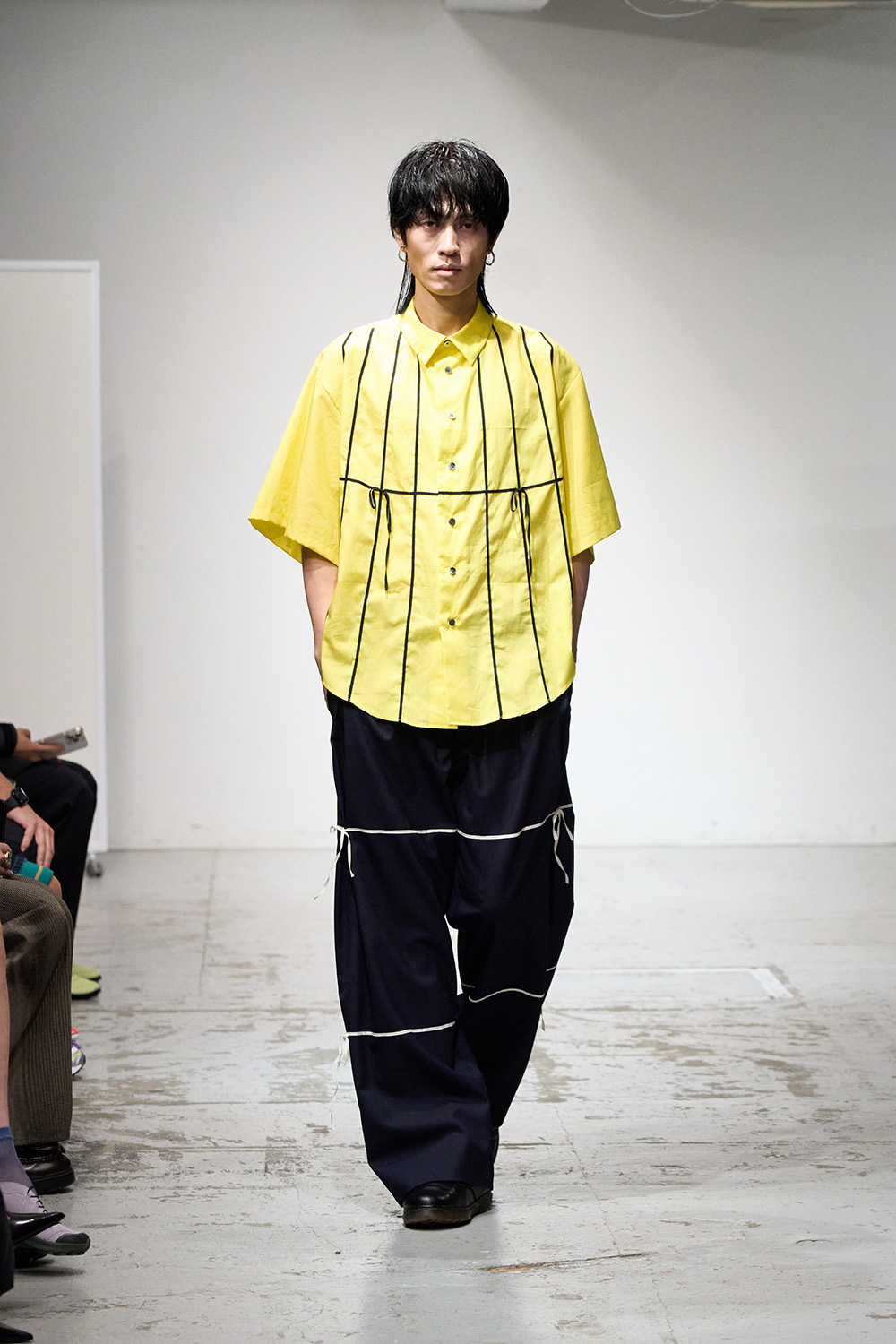
Yellow blueprint

After all that navy and gray, yellow arrives like someone switching on the lights.
The oversized short-sleeve shirt is crossed with thin black lines and small ties, echoing the cord work seen earlier. Against the yellow, however, those lines become much more graphic. The shirt resembles a blueprint drawn after the building has already been painted.
Pairing it with the navy corded trousers creates continuity without making the outfit feel overly coordinated. The proportions are also exactly where I want contemporary menswear to be: generous without drowning the wearer, relaxed without looking careless.
I would wear this. Easily. Sometimes the strongest endorsement a fashion editor can give a runway look is wanting to remove it from the runway entirely.
Living grid

The black floor-length look takes the collection’s recurring grid and pushes it furthest.
White cords divide the garment vertically and horizontally while black fabric sections project outward between them. From a distance, the body appears enclosed inside a loose cage. Up close, the structure feels much softer, almost like fabric samples suspended from a framework.
I thought of installation art here, particularly the way contemporary artists use grids to organize objects without completely controlling them. The white lines impose order, while the black panels repeatedly break it.
That contradiction makes this one of the collection’s most compelling statements. It is clothing behaving like an object in a gallery, but there is still a person walking inside it. With every step, the geometry changes.
Leave it showing
By the end of MITSURU OKAZAKI’s Spring/Summer 2027 show, I realized the detail connecting my favorite moments was exposure. OKAZAKI kept bringing forward things that fashion normally resolves or conceals: construction lines, ties, overlapping pieces, pockets, edges and layers. Instead of polishing away evidence of the garment-making process, the collection turned that evidence into its personality.
That feels particularly relevant now. We live in an era of impossibly smooth digital images, algorithmically perfected feeds and increasingly convincing artificial surfaces. Against that backdrop, there is something satisfying about clothes that visibly acknowledge how they were assembled. A knot looks like a knot. A panel behaves like a panel. A loose end is permitted to remain loose.
But I would not reduce Spring/Summer 2027 to a meditation on construction. The collection is simply too much fun for that. The yellow shirt, runaway blue panels, giant trousers and wandering cords give these clothes humor. They have ideas, but they are not standing in the corner explaining themselves to you.
That is ultimately why I responded to MITSURU OKAZAKI this season. OKAZAKI makes experimentation feel wearable rather than precious. You can appreciate the architectural thinking, the manipulation of familiar menswear and the almost art-school pleasure of seeing a blazer behave incorrectly. Or you can simply look at those enormous navy trousers and think: I want them.
I certainly did.
MITSURU OKAZAKIの2027年春夏コレクションを見て、改めて服はもっと自由でいいのだと思った。特に心に残ったのは、真面目さの中にある遊び心と、思わず近くで見たくなるようなディテールだ。ランウェイを見ながら、自分ならどう着るだろうと何度も想像していた。ショーが終わったあとも、もう一度見たいと思える服がいくつもあった。
Leave a Reply