Thirty-eight centimeters does not sound like the beginning of a fashion collection. It sounds like a measurement scribbled beside a pattern, the kind of number most of us would never notice. For MIZEN, it becomes the whole conversation.
For its Spring/Summer 2027 presentation at Rakuten Fashion Week Tokyo, MIZEN began with the traditional width of kimono fabric: 38 centimeters, roughly one-quarter the width of conventional garment textile. On paper, that narrow strip should be a designer’s headache. MIZEN treats it more like an invitation.
The collection, titled “WHAT 38CM TELLS,” asks another question underneath that measurement: Who gets to be the author of fashion? MIZEN’s presentation notes contrast the designer, whose vision usually receives top billing in fashion, with the artisan, whose technique traditionally carries the value of craft. Instead of choosing one, the collection tries to put them at the same table.
I found that proposition compelling because fashion’s relationship with craft can sometimes feel like tourism. Traditional techniques are borrowed, polished and presented as evidence of authenticity. MIZEN’s approach feels more conversational. The kimono is not treated as a museum object to be faithfully reproduced, nor as raw material waiting to be made “modern.” The clothes ask what contemporary dressing can learn from the restrictions and knowledge already embedded in it.
And then there is that blue. Electric, watery, almost digital. Against quiet gray tailoring and white shirting, it moves through the presentation like someone dragged a cursor across the wardrobe and highlighted the parts we were supposed to notice.
Blue current

The first selected look makes MIZEN’s argument easy to understand without turning it into a lecture.
A pale blue tailored jacket and crisp white shirt establish the familiar language of contemporary dressing. Below them, loose turquoise trousers change the frequency completely. Their scattered white marks have the irregular rhythm of brushstrokes, woven signals or fragments of handwriting.
What I like is the refusal to make “traditional” and “modern” occupy separate halves of the body. The jacket does not simply westernize the textile, nor do the trousers read as costume. They meet somewhere in between. Small flashes of darker blue emerge at the cuffs, almost like the fabric is escaping the jacket.
There is something almost Hockney-like about the color combination. That swimming-pool blue against pale tailoring has the clean brightness of sunlight hitting water. Yet the fabric keeps the look tactile rather than graphic. You want to get closer.
This is cultural dialogue conducted through clothes rather than slogans.
Electric pause

Here, MIZEN strips away much of the craft spectacle and gives us something almost startlingly direct: a brilliant blue cropped top with wide gray trousers.
The top gathers softly around the body, creating volume without weight. Its high neckline gives it composure, while the exposed strip of waist prevents that composure from becoming conservative. Below, the trousers fall with the looseness of something borrowed from a suit several sizes larger.
Blue and gray should not be this exciting. Somehow, they are.
I particularly like the tension between the saturated top and corporate-looking trousers. It feels like somebody walked out of an office, changed one thing and suddenly discovered another personality. In an era when dress codes have become increasingly porous, that seems remarkably current.
Sometimes the smartest transformation is not rebuilding the entire wardrobe. It is changing the voltage.
Measured layers

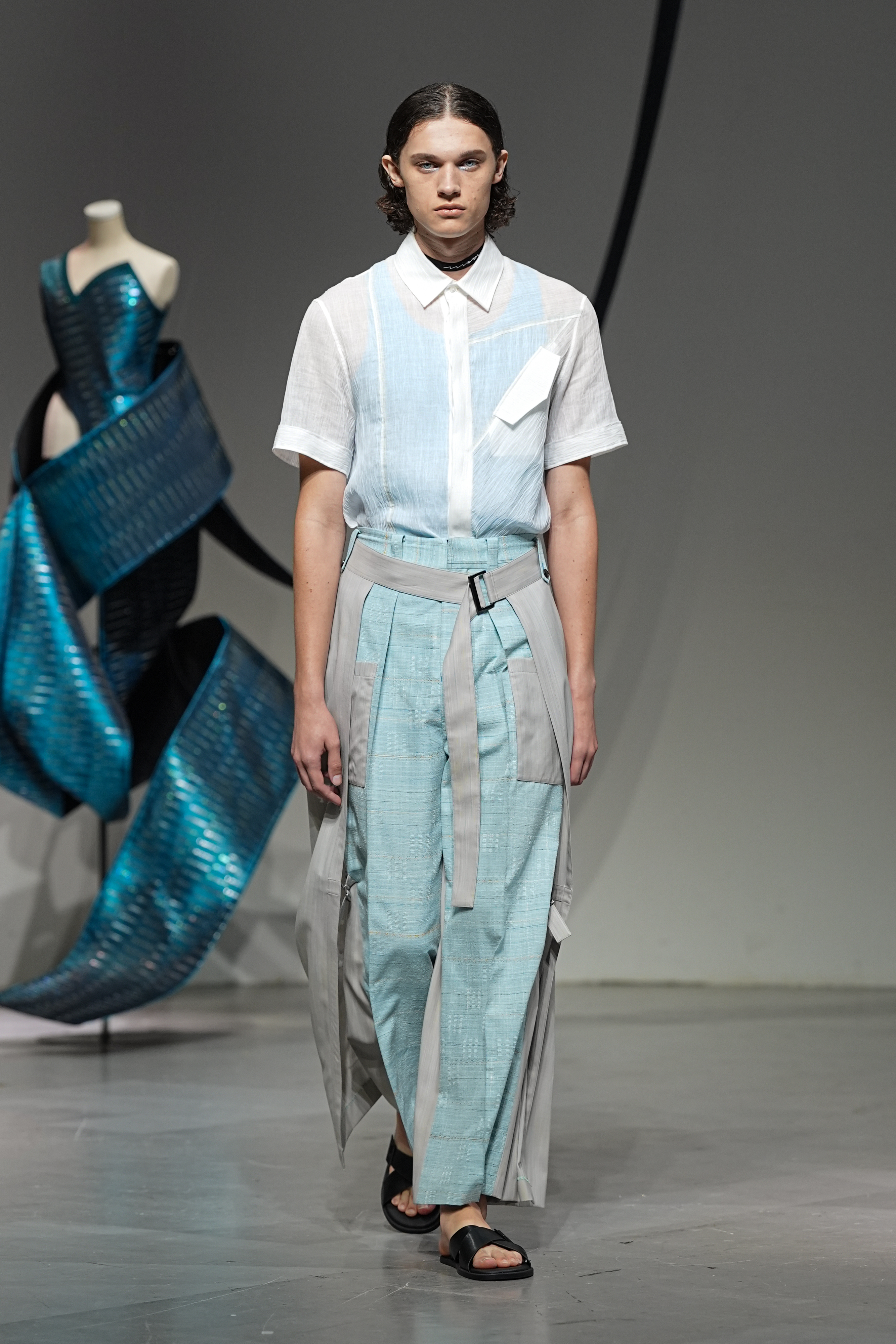
This look brings the 38-centimeter idea closer to the surface.
A translucent white short-sleeve shirt reveals pale blue beneath it, while the trousers appear assembled through contrasting vertical sections of blue and gray. A long gray belt drops from the waist like another strip waiting to become part of the garment.
The verticality matters. Once you know MIZEN is working from the logic of narrow kimono cloth, you begin seeing width differently. Instead of asking why a garment is divided into panels, you start appreciating what those divisions can produce.
I also love how approachable this outfit remains. Strip away the conceptual framework and someone could simply wear it. That is important. Craft does not need to announce itself with ceremonial seriousness to retain its meaning.
The outfit reminds me of a collage in which you can still see where one piece of paper ends and another begins. The joins are not imperfections. They are the composition.
Office shock

This might be one of the collection’s clearest collisions between two wardrobes.
An oversized gray double-breasted jacket and matching shorts could belong to the current language of relaxed city tailoring. Then a blast of turquoise appears underneath, with more blue material curling outward from the cuffs.
Suddenly, the gray suit becomes a frame.
I love that reversal. Normally, the colorful textile would be the decorative addition and the suit would be the main event. Here, the tailoring seems almost designed to direct your eyes toward what is underneath. The artisan’s contribution is not supporting cast. It steals the scene.
The proportions help. Long jacket, roomy shorts, bare knees, black loafers. Nothing feels precious. It is youthful without trying desperately to prove that it understands youth.
If MIZEN’s question is whether technique can become fashion’s protagonist, this look answers with a pretty convincing yes.
Split screen

This asymmetric look feels like two ideas meeting before either agrees to surrender.
A cropped vest uses a pale, multicolored textile on one side while white fabric folds and interrupts it on the other. Below, a softly pleated white skirt is crossed by another panel of the patterned material, extending downward at an angle.
It resembles a split screen, one image slightly overlapping another.
There is an echo of Japanese ideas of asymmetry here, but what interests me more is how contemporary the result feels. We live through multiple windows now. Phones, laptops, feeds and tabs constantly divide our visual field. This outfit somehow carries that fragmented way of seeing without becoming technological cosplay.
The flashes of yellow and blue are especially effective against white. They arrive like annotations in the margin.
Tradition here does not sit quietly in the background. It interrupts.
Full volume

Then MIZEN turns up the blue until there is almost nowhere else to look.
The patterned turquoise textile takes over a layered ensemble of shorts, a wrapped top and an outer garment that falls behind the body. Black piping cuts across the blue, giving the eye a route through all that color.
This is where the collection’s craft proposition becomes exuberant.
What might have been preserved as precious kimono cloth is allowed to become energetic, casual and even a little swaggering. The wrapped construction nods toward kimono dressing without pretending that the wearer has stepped out of another century. Shorts and loafers keep the look firmly in the present.
I appreciate that enormously. Respecting tradition does not require whispering around it. Sometimes respect means trusting a craft enough to let it have a new life.
Quiet relief

After the saturated blues, this pale ensemble feels like silence after music.
The sleeveless top is built from irregular horizontal ridges that travel across the body like contour lines on a map. Below it, wide, airy trousers fall almost like a skirt. The palette is restrained enough that texture becomes the subject.
This is the outfit where I found myself thinking most about the artisan’s hand. You can see the surface working. It refuses the anonymous smoothness we have become accustomed to from mass-produced clothing.
There is a kinship with Japanese paper here, particularly the pleasure of surfaces that record their own making. The ridges catch shadow, so the garment changes subtly depending on where the light lands.
And then MIZEN slips in yellow heels.
That small jolt prevents all the pale serenity from becoming overly reverential. It is the visual equivalent of someone cracking a joke in a very beautiful room.
Thirty-eight expanded

The final selected look takes the collection’s narrow starting point and blows it wide open.
Deep navy fabric forms the foundation of a floor-length dress, while luminous turquoise textile travels across the bodice and skirt in broad geometric sections. The material appears almost metallic under the lights, its horizontal markings flashing as the wearer moves.
Here, 38 centimeters no longer feels restrictive. It feels architectural.
The construction reminds me of folded planes, somewhere between origami and the sweeping curves of contemporary sculpture. But the garment never becomes a geometry exercise. The asymmetry around the waist gives it motion, as though those narrow lengths of cloth are still deciding where they want to go.
It also brings the presentation full circle. The same blue textile visible on the sculptural form behind the models now takes command of the body itself. Craft has not been reduced to a detail, citation or decorative insert.
It has become the event.
Width of possibility
What stayed with me after MIZEN’s Spring/Summer 2027 presentation was not simply the beauty of a particular textile. It was that stubborn number: 38 centimeters.
Fashion usually talks about freedom as though freedom requires removing restrictions. More fabric. New technology. Faster production. Infinite references. MIZEN suggests the opposite can also be true. A boundary can force a more interesting conversation.
That is why “WHAT 38CM TELLS” works beyond its premise. The collection does not ask us to admire Japanese craft because it is old. Age alone is not an argument for relevance. Instead, MIZEN asks what knowledge is stored inside a technique and what happens when a contemporary designer actually listens to it.
Across these looks, gray suiting meets saturated blue, sheer shirting exposes layered construction, narrow panels become trousers and skirts, and familiar kimono logic slips into clothes that belong unmistakably to the present. The designer and artisan do not appear to be fighting for authorship. Their fingerprints overlap.
That feels particularly meaningful now, when fashion can be generated, copied, manufactured and circulated at astonishing speed. The hand becomes more interesting precisely because we are increasingly surrounded by things that seem to arrive without one.
MIZEN does not answer every philosophical question posed in its presentation notes, and it does not need to. Clothes are more persuasive when they demonstrate an idea instead of explaining it to death.
I came away convinced of something much simpler.
Give MIZEN 38 centimeters, and the brand will find an entire world inside it.
Leave a Reply