There is something strangely intimate about seeing the inside of a garment. We are accustomed to fashion presenting itself after the evidence has been cleaned up: seams tucked away, linings concealed, construction made invisible. SONIA CARRASCO’s Spring/Summer 2027 collection asks why we are so determined to hide the work.
Presented Sept. 3 at Shibuya Hikarie during Rakuten Fashion Week Tokyo, the collection began with a deceptively simple question about tailoring: What belongs inside a garment? Carrasco’s answer was not to tear tailoring apart but to gently rearrange its grammar. Linings, seams, unfinished edges and structural elements migrated outward, becoming visible without becoming theatrical. She describes the exercise not as deconstruction, but as a search for equilibrium. That distinction matters.
Watching the collection, I kept thinking about an architect exposing the pipes and concrete of a building rather than covering them with drywall. There are echoes of modernist architecture here, particularly the belief that understanding how something is built can make it more beautiful, not less. The runway itself extended that thinking. Inspired by the column grid of the Thersilion at ancient Megalopolis, the seating transformed rigid geometry into a less predictable path, with models moving through the negative spaces between people. Structure was everywhere, but nothing felt trapped by it.
What impressed me most was Carrasco’s restraint. Fashion loves ripping things apart and calling the wreckage radical. Carrasco does something quieter. She opens the garment, lets us look around and then puts it back together according to slightly different rules.
Soft authority

This gray look makes a strong argument for tailoring without stiffness. A long, belted coat carries familiar traces of the trench, from the shoulder details to the broad lapels, yet it seems to have relaxed after leaving the office. Its surface has movement rather than military rigidity, and the rolled sleeves release flashes of a crisp white shirt underneath.
The proportions are particularly good. Fabric gathers around the waist before falling into a long, almost uninterrupted column over matching trousers. Even the belt knot feels less like fastening and more like somebody casually tying together an idea before leaving home. Gray sandals further dismantle the expected formality. A conventional tailored coat normally asks for polished shoes. Carrasco sends it out with exposed toes.
That tension is exactly where the collection becomes interesting. The clothes know the rules. They simply do not feel obligated to behave.
Working draft

This gray ensemble looks as though somebody caught a blazer halfway through becoming something else and decided that was the most interesting moment.
An oversized sleeveless jacket sits over a loose shirt and an asymmetric skirtlike layer, creating a silhouette that shifts between tailoring, shirting and something closer to workwear. The exposed edges and visible stitching around the shoulders make the garment’s construction part of its personality. You can almost imagine chalk marks and pins still sitting on a cutting table.
That could easily become costume. It does not. The muted gray palette keeps everything grounded, while brown leather shoes introduce an unexpectedly traditional note. Then there is the long, narrow bag carried over the shoulder, its proportions recalling the garment carrier Carrasco reworked for the collection. It is an amusing object because it turns the equipment used to transport tailoring into part of the wardrobe itself.
The result reminds me of an artist’s studio when the sketches taped to the wall become more compelling than the finished canvas. Carrasco understands that process can have its own beauty.
Suit, interrupted

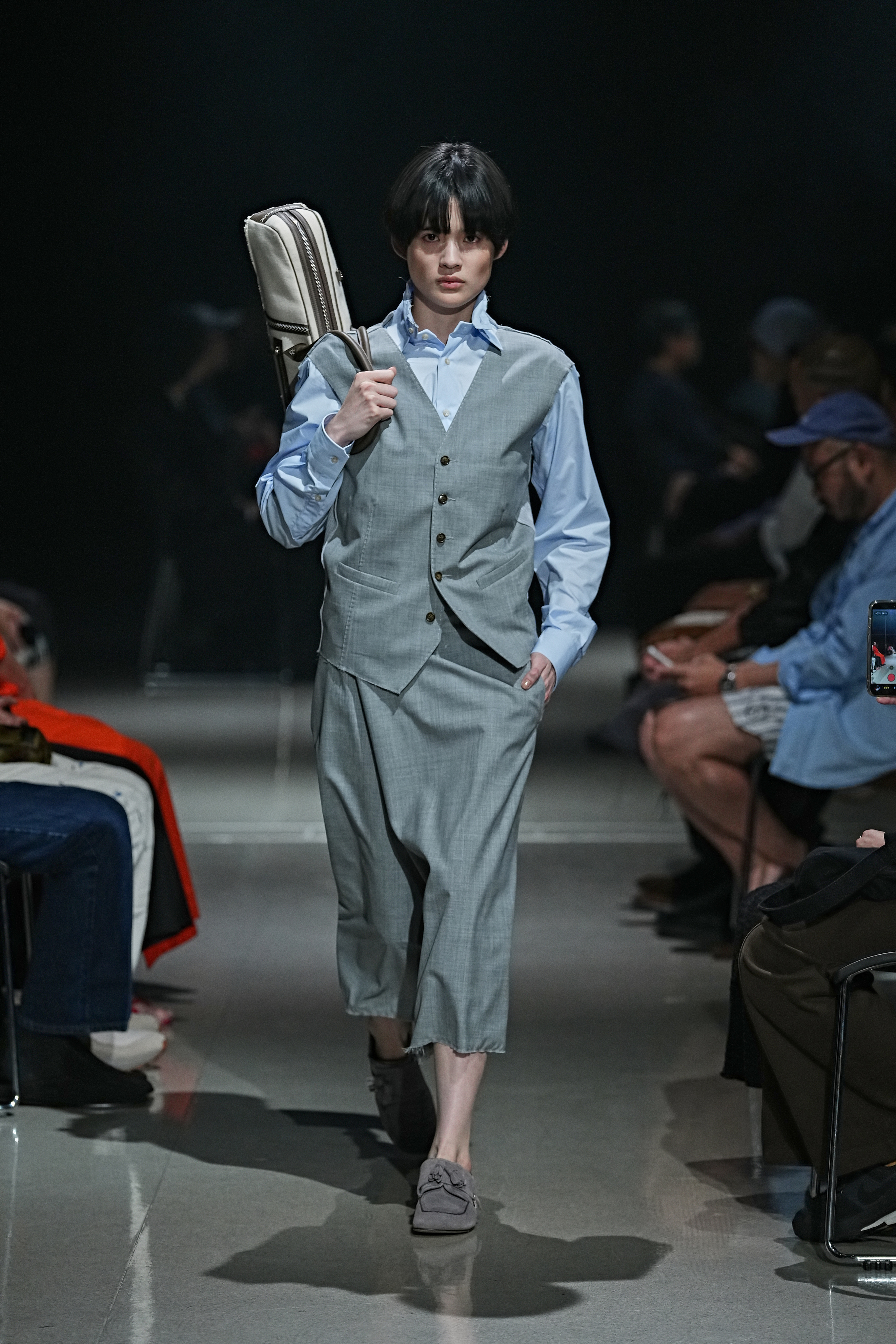
Here, Carrasco reduces the experiment to something almost ordinary: a pale blue shirt, gray waistcoat and matching trousers. Look again.
The vest is familiar enough to belong to a three-piece suit, but the trousers stop abruptly below the knee with raw hems. The shirt collar appears unsettled rather than perfectly pressed into place. And once again, the elongated carrier bag sits over the shoulder like a portable piece of the atelier.
I like this look precisely because it does not scream for attention. It whispers its oddities. From across the room, you see tailoring. Up close, you begin noticing that the sentence has been rearranged.
There is something contemporary about that proposition. Formal dress in 2026 exists in a strange place. Offices have relaxed, sneakers have invaded suits and traditional distinctions between men’s and women’s wardrobes increasingly feel inadequate. Carrasco does not respond by abandoning tailoring. She asks what tailoring can become once those old expectations loosen their grip.
White space

After all that gray, this nearly all-white look feels like opening a window.
A roomy button-down shirt stretches downward into layered shirting around the hips, paired with very short shorts and black woven shoes. The contrast between the substantial upper half and bare legs creates a silhouette that feels deliberately unfinished, as though a conventional shirt has continued growing while the trousers have quietly disappeared.
But the cleverness is in how little Carrasco needs to make it work. White fabric becomes her blank sheet of paper. Pockets, seams, hems and layers become easier to read because color is no longer competing for attention.
It reminded me of Robert Rauschenberg’s white paintings, works that initially appear empty until light, shadow and the surrounding room begin changing them. Carrasco’s white is similarly active. Movement supplies the decoration. As the model walks, the hanging panels separate and overlap, turning a simple shirt into architecture in motion.
Loose threads

This was the look that made me want to reach toward the runway.
A fitted ivory knit top sits above a skirt covered in cascading loops of yarn. From a distance, the skirt resembles fringe. Closer inspection makes it feel stranger and more tactile, almost like hundreds of unfinished threads have escaped the garment and been allowed to hang freely.
The pairing is smart because the top refuses to compete. It is clean, close to the body and almost domestic in its familiarity, leaving the skirt to move like a textile drawing below it. Every step changes the surface.
There is a little fiber art in the effect, a reminder of artists who rejected the idea that textiles belonged only to craft and pulled them into galleries as sculpture. Carrasco accomplishes something similar on the body. The yarn is not merely embellishment. It makes construction visible through movement.
And I love that it looks touchable. So much contemporary fashion seems designed primarily for the camera. This asks you to imagine what it feels like between your fingers.
Safari rewrite

Khaki tailoring comes with considerable cultural baggage. It can summon safari jackets, military uniforms, expedition clothing and the fantasy of the gentleman adventurer. Carrasco borrows that visual vocabulary and messes with its confidence.
The jacket has black lapels that suggest eveningwear, while a drawstring pulls the waist inward. Matching knee-length shorts immediately remove whatever boardroom seriousness remains. Underneath, a brown V-shaped layer peeks over a white shirt, adding another visible piece of the garment puzzle.
Then comes the large brown leather bag. Rather than feeling precious, it looks useful, almost like something designed to swallow half a person’s day.
What could have become nostalgic instead feels current. This is tailoring for someone moving through a city rather than posing behind a desk. Put it on a Tokyo sidewalk, a Barcelona platform or outside a gallery in London and it makes sense. The past is present, but Carrasco refuses to reenact it.
Quiet evidence

The black double-breasted suit initially appears to be the collection’s most conventional proposition. After so much exposed construction and shifted proportion, here comes the familiar dark suit and tie.
Then you notice the shoulders.
Small white markings sit against the dark fabric like tailor’s chalk or construction notes that were never erased. White cuffs emerge beneath the sleeves, interrupting an otherwise nearly monochromatic composition. These details are tiny compared with the interventions elsewhere, and that is why I find them so effective.
Carrasco turns the suit into evidence of its own making.
It recalls the fitting room more than the boardroom, the moment when a tailor steps back, studies the shoulder and marks what still needs adjusting. Normally, those traces disappear before the customer ever sees the garment. Here, they become the point. The finished suit carries the ghost of the hands that built it.
There is something almost rebellious about doing so little.
Leave the seams
By the end, SONIA CARRASCO had not destroyed tailoring. She had made me look at it more closely.
That is a harder trick than spectacle. Anyone can enlarge a shoulder until it becomes architecture or send an outrageous object down a runway and guarantee a photograph. Carrasco’s proposition requires attention. A hem stops where you do not expect it to. A lining emerges. A construction mark remains. A familiar garment seems to have been turned a few degrees, just enough for you to see a side that usually faces the body.
The strongest idea running through the Spring/Summer 2027 collection is that construction does not have to disappear for clothing to feel complete. Carrasco treats the evidence of labor almost like handwriting. You see where something was cut, joined, adjusted or left open. The human hand remains in the final sentence.
That is also why the collection’s conversation between tailoring and knitwear works. One relies on control and structure; the other can stretch, hang and respond to the body. Carrasco allows those instincts to rub against each other rather than forcing either one to win.
I left thinking less about individual trends than about the peculiar obsession fashion has with perfection. We are taught that luxury means hiding every loose thread and disguising every mechanism. Carrasco proposes another kind of luxury: knowing exactly how something was made and allowing that knowledge to remain visible.
Sometimes the most interesting part of a garment is the part we were never supposed to see.
Leave a Reply