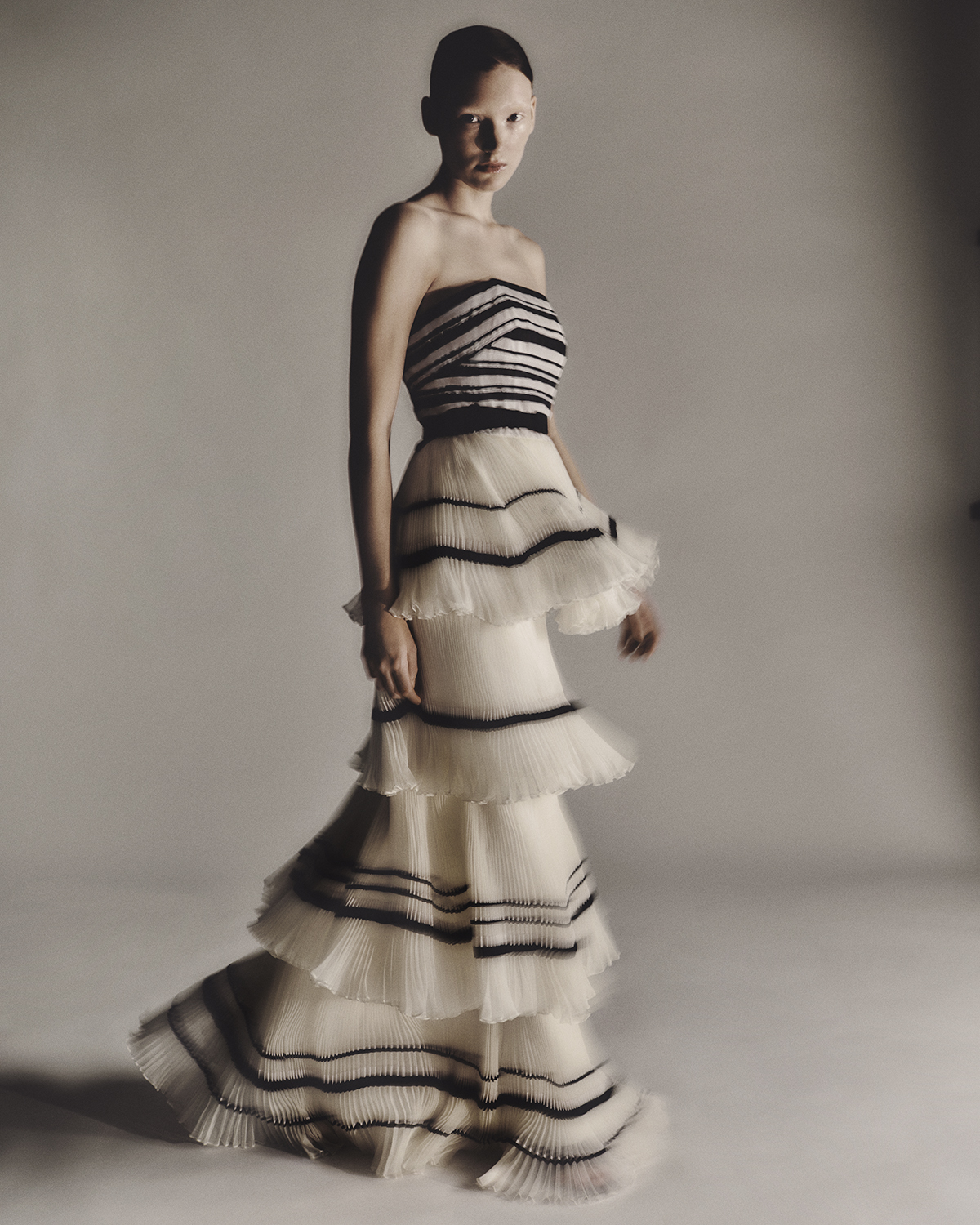
There are collections that introduce themselves in the first look. Then there are collections that prefer to let you lean in. byFANG’s FW26/27 Couture collection, presented during Paris Fashion Week, belongs firmly in the second camp.
What immediately pulled me in was not extravagance. It was restraint. Every pleat, feather and sculpted fold feels like it arrived after a long conversation rather than a last-minute flourish. The clothes never seem interested in proving how complicated they are. Instead, they quietly invite you to notice them, one detail at a time. That patience is refreshing in a moment when fashion often feels trapped in an endless race to become the next viral image.
The collection moves between softness and precision with surprising ease. Cream ruffles meet graphic stripes. Feathers interrupt clean silhouettes. Rich chocolate satin shares the runway with architectural pleats that feel more like gallery installations than garments. There are echoes of paper sculpture, ballet and origami-like folds, yet none of those references overpower the woman wearing the clothes. I also caught flashes of contemporary sculpture, where negative space becomes just as expressive as the object itself.
That is what impressed me most. Couture can sometimes feel like an exercise in spectacle. byFANG chooses something more interesting. These are clothes that ask you to slow down. In a culture obsessed with instant reactions, that feels almost rebellious. By the time the final look left the runway, I realized I wasn’t chasing the next dress. I was paying attention to the spaces between the folds, the movement of the fabric and the quiet confidence stitched into every silhouette. That is a feeling far more difficult to create than spectacle, and far more rewarding to experience.
Soft armor

Some dresses ask for attention. This one quietly changes the temperature of the room.
The cream pleats move like paper lanterns caught in a slow breeze, while the graphic striped straps slice through the softness with just enough tension to keep everything awake. It feels as if a ballerina wandered into a gallery showing of Constructivist art and refused to choose between romance and structure.
I keep coming back to the waist. Those sculpted floral clusters interrupt the dress like small conversations that refuse to end. They stop the eye, then send it downward into cascading tiers that never feel heavy despite their volume.
There is something very current here. Fashion has spent the past few years chasing loudness. This look chooses restraint instead. That confidence feels louder than sequins ever could.
Quiet rhythm

Black stripes usually belong on sailors or Breton sweaters. Here, they become sheet music.
The bodice reads almost like a modern graphic poster before dissolving into airy layers that float somewhere between a wedding cake and folded Japanese paper sculpture. The repetition should feel predictable, but instead it creates movement long before the model even takes a step.
It reminds me of the clean geometry of Piet Mondrian softened by clouds.
What I enjoy most is how playful the collection becomes without losing its discipline. Every stripe has a purpose. Every ruffle earns its place. Fashion often mistakes decoration for personality. This dress proves the two are not the same thing.
Midnight bloom

Black dresses often rely on sparkle to make an impression. This one lets shadow do the work.
The fitted bodice rises from the body almost like carved obsidian before exploding into a burst of feathers around the hips. It is part evening gown, part raven taking flight.
There is a subtle theatrical quality that recalls old Hollywood portrait photography, where the absence of light became just as important as the light itself.
I like that the silhouette never tries too hard. The feathers provide enough movement while the clean skirt keeps everything grounded. Sometimes fashion’s strongest statement is knowing exactly when to stop.
After dark

This feels like the moment after the party, when elegance finally exhales.
The embroidered off-the-shoulder bodice almost dissolves into skin before flowing into a liquid chocolate skirt that catches light like polished wood. There is an intimacy here that many evening gowns miss because they chase spectacle first.
The color choice deserves applause. Deep brown continues its quiet return to fashion, replacing predictable black with something warmer and more human.
It reminds me of the muted palettes in Renaissance portraiture, where richness came from tone rather than ornament. This is luxury that trusts the viewer to notice.
Shadow play

Ending the lineup in black and white feels intentional, almost like the final frame of an art-house film.
The shimmering surface catches light in narrow streams, creating a pattern that resembles tree bark, rippling water or brushstrokes in an ink painting. Feathered shoulders introduce softness without interrupting the long, uninterrupted silhouette.
There is a quiet confidence in presenting glamour through monochrome. It recalls Irving Penn studio portraits where shape always mattered more than excess.
This look leaves the strongest aftertaste because it never shouts for applause. It simply stands there, letting texture, proportion and presence finish the sentence. That kind of confidence cannot be stitched into fabric. It has to be designed.
Red signal

If the previous looks whisper, this one leans forward and speaks.
Those sculptural pleated circles bloom across the bodice like oversized poppies, but they also resemble vinyl records frozen in mid-spin. There is something almost cinematic about them, recalling the theatrical silhouettes of classic opera costumes while feeling perfectly suited to today’s red carpet appetite for sculptural fashion.
The monochromatic red removes distraction. Texture becomes the conversation.
This is the kind of look that reminds me why couture still matters. It turns fabric into sculpture without forgetting there is a person inside it. It is dramatic without ever feeling like costume, and that is harder than it looks.
The last look
Walking away from byFANG’s FW26/27 Couture collection, I kept thinking less about individual dresses and more about the feeling they left behind. They linger the way certain photographs do, revealing something different each time you return. One moment it’s the movement of a pleated hem. The next it’s the quiet confidence of a feathered shoulder or the unexpected warmth of deep brown satin.
There is a generosity to byFANG’s design language. The collection never overwhelms the eye with unnecessary noise, yet it never feels restrained for restraint’s sake. Every look offers a different conversation while speaking the same visual language. That kind of consistency is difficult to achieve because it depends on conviction rather than excess.
Fashion does not always need to raise its voice to leave an impression. This collection understands that. It trusts shape, movement and emotion to carry the story forward. By the final look, I wasn’t simply looking at gowns. I was watching fabric behave like memory, shifting with every step and refusing to settle into a single interpretation.
Paris Fashion Week always offers plenty to remember. Few collections make me want to look twice before moving on. byFANG’s FW26/27 Couture collection did exactly that. And in a season where attention has become fashion’s most valuable currency, I cannot think of a stronger compliment.
Leave a Reply