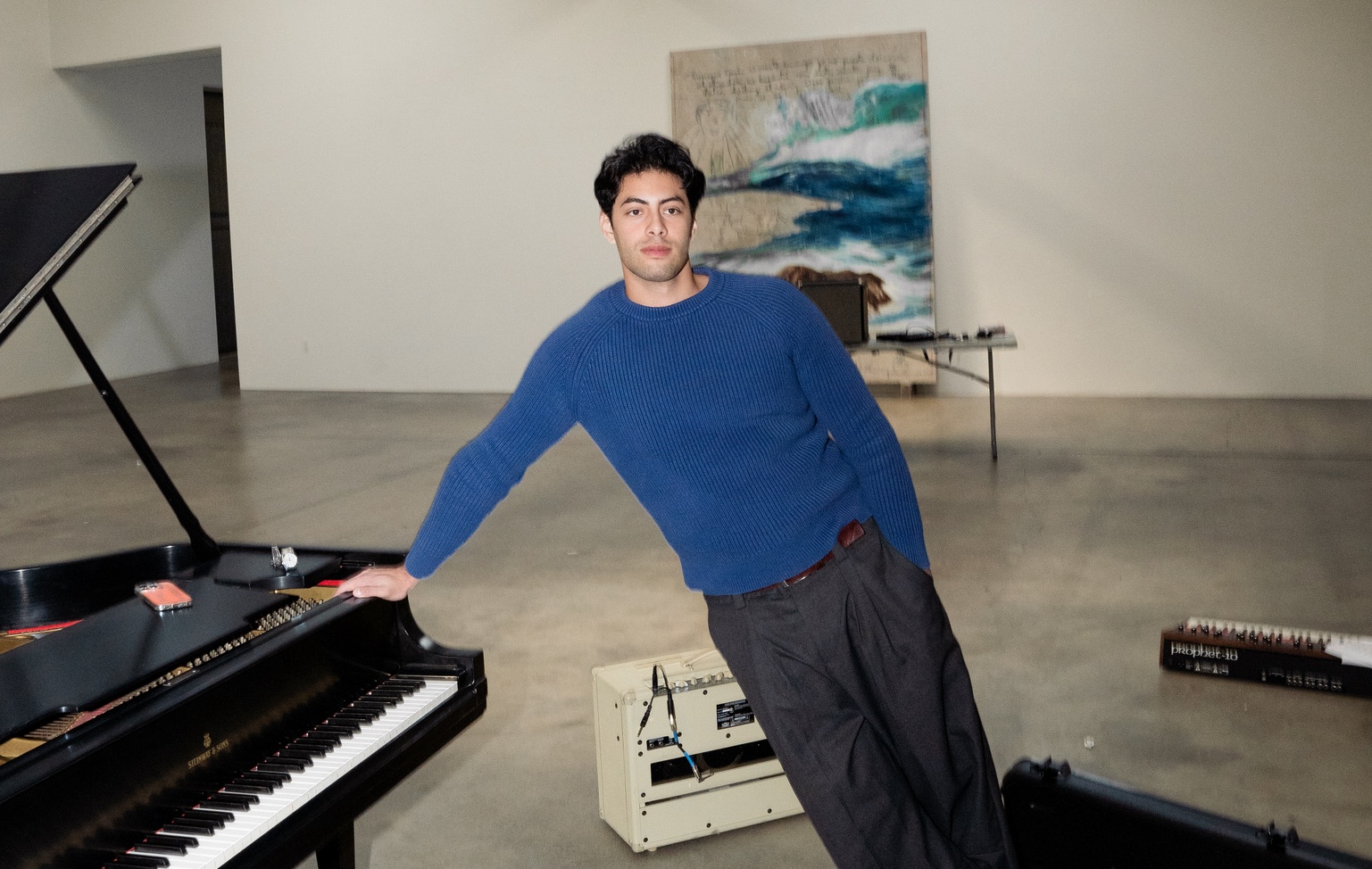
Before piano recitals, Ian Cobiella’s mother gave him the same instruction every time: Give everything, even if you make a mistake.
“That idea stayed buried in me for a long time,” Cobiella said. “Recently, I realized I’ve applied it not just to music, but to my life as a whole. It hasn’t always been easy, but it’s shaped the way I move through the world and the way I make music.”
That perspective anchors “Trial By Fire,” the latest single and music video from the Los Angeles singer-songwriter. The track is reflective and restrained, exploring what it means to commit fully, face an outcome that does not match the effort and still find a way to accept it without bitterness.
For Cobiella, that level of emotional clarity required a shift away from his classical training. He began as a pianist, learning how to interpret compositions within a structured framework. Over time, that structure no longer felt like enough.
“Classical piano taught me how to feel deeply within structure and how to honor the emotional world of a piece,” he said. “But it also asks you to interpret someone else’s voice and life. As I got older, I wanted to speak more directly and be specific about what I was feeling in real time. A piano can express almost anything, and I still believe that, but words cut through in a different way.”
That transition into songwriting opened a more personal lane, one that allows him to document emotions as they happen rather than revisit someone else’s. “Trial By Fire” reflects that immediacy, built not on a single defining moment but on a pattern of lived experiences.
It is a track that does not rush toward resolution. Instead, it lingers in discomfort, allowing space for uncertainty. Cobiella said that discomfort has become an important part of his creative process.
“Everyone I care about has always told me that if you sit with discomfort, you grow,” he said. “I think I’ve taken that to heart. Some of my best writing has come from staying in that space a little longer instead of rushing past it.”
That willingness to sit with difficult emotions also shapes how he reflects on his past. In revisiting earlier experiences, he said he recognized a tendency to overanalyze and hold himself to an unforgiving standard.
“I realized I need to relax sometimes,” Cobiella said. “I have a tendency to tie myself up in a tiny corner, like a house spider, replaying things and almost defaulting to holding a grudge against myself. Then I step back and realize it’s genuinely not that deep. I probably just needed to go on a walk with my dog.”
That shift in perspective informs what acceptance looks like for him in practice. Rather than a broad or abstract concept, it is tied to everyday routines that bring him back to the present.
“Going on a walk with my dog, Petunia. Playing piano without any real agenda,” he said. “I used to post my running route on my Instagram story before heading out, and sometimes friends nearby would drive over and join me for part of it. That always grounded me in a way I can’t fully explain. I think acceptance, for me, looks like returning to those small moments instead of overthinking everything.”
Cobiella’s music is also shaped by his Cuban and Bolivian upbringing, which he said continues to influence how he approaches emotion and storytelling. Raised on a range of Latin genres, he said those sounds instilled a sense of boldness and clarity in expression.
“My mom and grandma raised me on the music that made them fall in love with life. The Spanish language itself is very beautiful,” he said. “My mom used to show me Argentine rock, Bolivian folk, Cuban salsa and Brazilian samba. Everything was big, declarative, a little romantic in the grand sense. That kind of music wires your brain early. My brain is wired in declarations. Latin music is incredibly declarative. It only feels right to honor that.”
That sense of declaration carries into his songwriting, even when it comes with vulnerability. He acknowledged that expressing something honestly can feel like a risk, though not necessarily a sacrifice.
“Maybe an arm and a leg, maybe a little embarrassment?” Cobiella said. “I don’t feel like I’ve cashed anything in to make a declaration. If it feels right, it feels right.”
The production of “Trial By Fire” mirrors that philosophy. Working with producer and mixer Jackson Haile, Cobiella said the goal was to preserve intimacy rather than overpolish the track.

“We just knew that this song had to be intimate,” he said. “I remember we recorded with a very nice guitar at the studio, and it just didn’t sit right. What ended up being the solution was my Fender acoustic that I begged my mom for at Costco when I was 12. It formed my playing and really carried the familiarity and closeness the song needed.”
That decision to use a familiar instrument reflects a broader commitment to authenticity. Instead of prioritizing technical perfection, the song leans into texture, memory and subtle imperfections.
The same approach extends to the music video, which focuses on everyday moments rather than dramatic or staged scenes. Cobiella said those smaller interactions often reveal more about connection and resilience than larger gestures.
“Grand acts are beautiful, truly, but in reality they aren’t sustainable,” he said. “Ordinary moments are a complete understanding of another person’s routine. It’s, ‘Hey, I remembered you told me this makes your life easier. I want to make your life easier.’ Romance is strongest when it comes from memory and thoughtfulness rather than spectacle.”
As his audience continues to grow, Cobiella said he tries to avoid overthinking expectations or pressure to present a polished image. Instead, he focuses on maintaining routines and relationships that keep him grounded.
“If I think about this too much, I might spiral a little, so I try not to,” he said. “I stay grounded in pretty simple ways: going to the gym, keeping some kind of routine, staying close to the people I love and spending time with my instruments. As long as I have those things, I don’t feel pressure to present perfection. I’m more interested in staying honest than in having everything figured out.”
With “Trial By Fire,” that approach remains consistent. The song does not attempt to resolve every question it raises. Instead, it offers a reflection on effort, vulnerability and acceptance, shaped by years of experience and a willingness to confront discomfort.
For Cobiella, the message is not about finding a perfect outcome, but about continuing to show up fully, even when the result is uncertain.
Leave a Reply