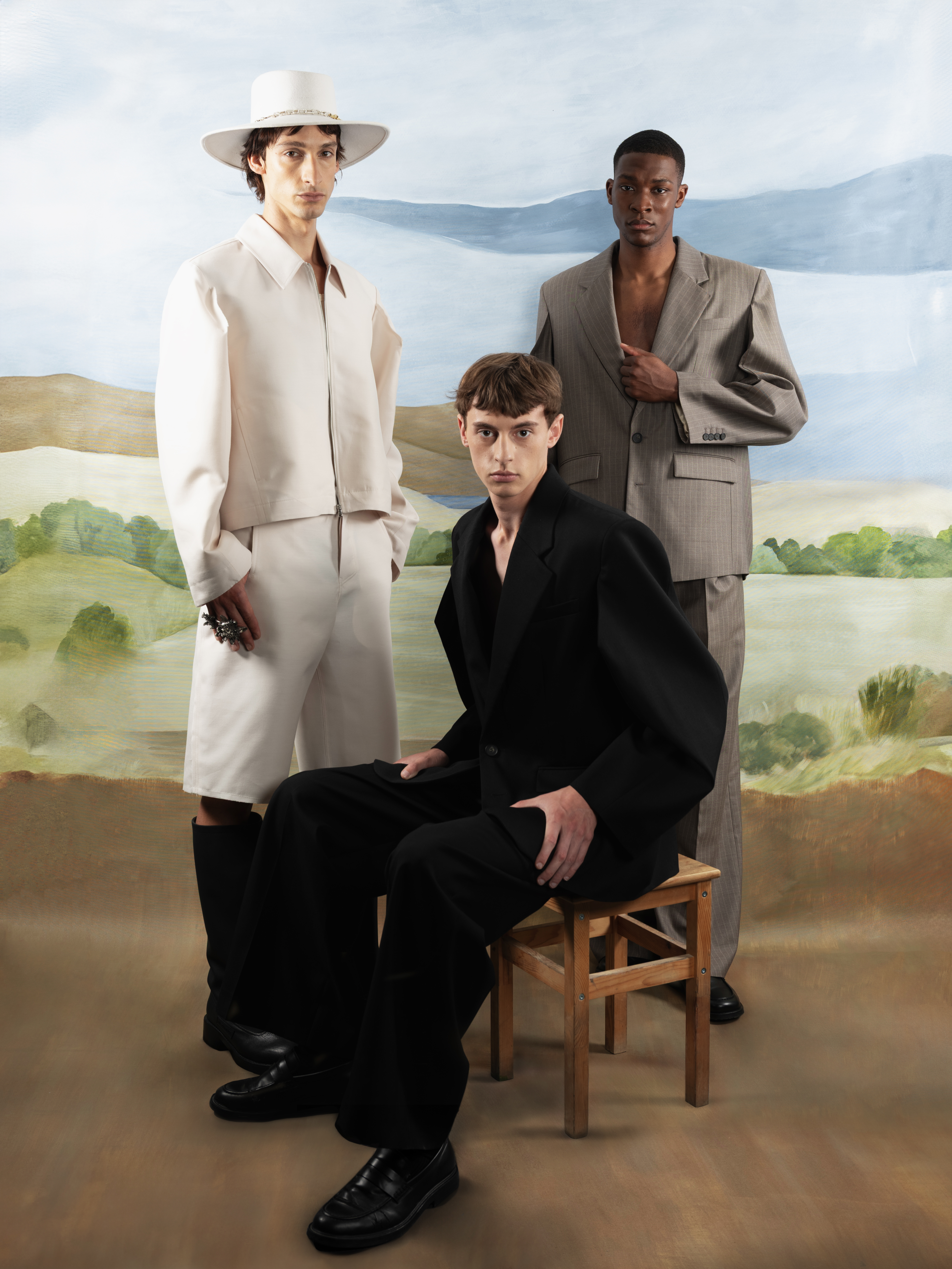
A gaucho’s silhouette. A shard of porcelain. Two women, one from France, the other from Argentina, sitting in quiet conversation. That’s how this collection began—intimately, without pretense.
For Girault Élise and Frias Belén, the duo behind CACHÍ, fashion isn’t trend-responsive or seasonal. It’s built like a language.
“Each collection is born of an intimate dialogue between us,” they said. “Between France and Argentina, the past and the future, our childhood memories and our crossed heritages.”
This season, that dialogue unfolds in hybrid silhouettes that lean into sculpture. The lines blur deliberately—between gender, between function and form.
“There was a desire to create shapes that would last, almost like timeless objects,” they explained. “Even though the collection is designed for a male wardrobe, its unisex aesthetic was a natural choice. Clothing becomes a space to inhabit.”
CACHÍ’s construction doesn’t chase visual gimmicks. It rests on deliberate contrasts. Robust gaucho references meet the fragile elegance of Limoges porcelain. The balance isn’t aesthetic; it’s conceptual. Garments are designed to bridge memory and modernity, rooted in personal and collective histories.

“Latin American heritage is not just an aesthetic reference,” Belén said. “It’s a founding language.”
From deconstructed ponchos to layered shapes, nothing is literal. The duo isn’t rehashing iconography; they’re reframing it. What emerges are silhouettes that are poetic without being fragile, assertive without demanding attention.
“Each piece becomes a story silhouette,” they added, “a balance between cultural memory and contemporary language.”
This narrative tension extends to the way they see their garments living beyond the studio. While they haven’t staged a formal presentation or performance yet, it’s clearly on their minds.
“We imagine our pieces in movement, in an atmosphere, not just posed or frozen,” they said. “Sound, movement, smell—these are elements that could really complement the garment and bring our world to life.”
There’s a dreamlike, cinematic quality to CACHÍ, and that’s no coincidence. Films and paintings are part of the design process. For SS26, they conjured a character—a silent man from the countryside, rooted and solitary. A figure not unlike a Caillebotte subject.
“He’s a little out of time,” Élise said. “That’s who we were designing for.”

In an industry obsessed with acceleration, CACHÍ resists. The duo works slowly, deliberately.
“We move forward in small layers,” they said. “Nothing is linear or forced.”
That slowness is a shield. It protects the intimacy of their process. It’s also a political gesture against disposability, against noise, against the assumption that relevance must be fast.
This approach extends to sustainability. They don’t parade it. They practice it. The collections use recycled materials and are produced in small runs. They work closely with artisans in France and Argentina.
“These are relationships based on trust and dialogue,” they explained. “What counts is that each piece has meaning, that it lasts over time—not only because of its quality, but because of its emotional charge.”
CACHÍ’s internal design process mirrors its clothes: two forces in dynamic tension. Élise is more intuitive, driven by material and volume. Belén is more conceptual, focused on narrative and structure. Together, they push each other.

“We share the same sensibility,” they said, “but we have different approaches. That’s what creates new paths. That’s how we avoid lazy decisions.”
Their relationship is creative and personal. The brand and their partnership grew in parallel. Every design carries traces of their conversation.
“Every detail, every finish seeks to connect our inspirations,” they said. “It’s not always obvious at first glance, but that’s where it all comes together.”
Looking ahead, they’re moving into new territory—homewares, decorative objects and deeper collaborations with artisans. These are new canvases, not brand extensions.
“We want to meet new people, share processes and learn to work with other techniques,” they said. “It’s these exchanges that feed our approach.”
Leave a Reply